


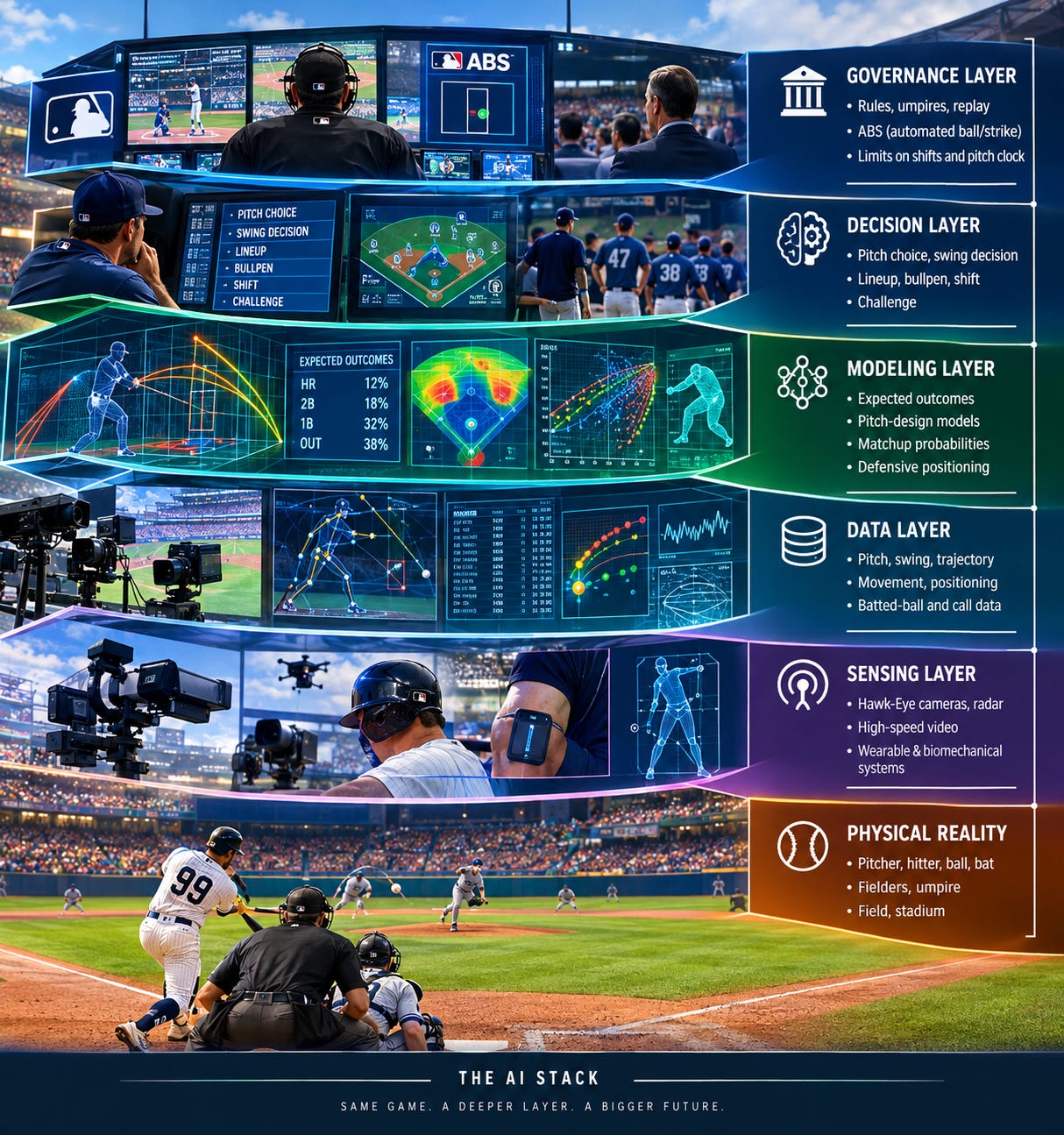
Baseball’s evolution from Moneyball to Statcast and ABS is a miniature of the sensor-saturated AI age: once everything can be measured, the advantage goes to organizations—like the #1 playoff seed Brewers at their best—that learn and adapt fastest.
I have been a Brewers fan since Bud Selig stole the Seattle franchise and brought baseball back to Milwaukee in 1970 (I was eight and my dad had been a big-time Milwaukee Braves fan). I played Little League and then Babe Ruth throughout my childhood, and my fondest memories with my father involved us driving 3 hours to County Stadium to catch double-headers. I curated a world-class 3D baseball card collection and routinely recorded games in my scorebook—as in, every single pitch, just like my dad taught me.
So, yeah, baseball has meant something to me over the years—a reassuringly analog religion.
Umpires called balls and strikes, scouts scoured the countryside for “the natural,” and managers pulled pitchers when their gut told them to do so. As for the fans, we argued incessantly about everything, but we did it based on what we saw more than the various stats that resulted.
Understand: The umpire did not merely adjudicate reality; he created it. The game, as experienced by the paying customer, was authoritatively rendered. Oh sure, your manager could get himself tossed, but that was mere protest and nowhere near actual contestation of the call.
That was the baseball I grew up with.
Then the Cameras Showed Up
Not the old network cameras, mind you, which barely moved. I mean the cameras that see everything. The cameras that track every pitch from hand to plate, map every inch of its journey (speed, spin, type, trajectory), determine balls-v-strikes, reconstruct every batted ball’s flight, clock every fielder’s first step, and—this is the crucial bit—establish a secondary but far more precise data-rich reality that can be called upon (“challenged”) by players and coaches.
Welcome to the age of omniveillant and omniscient baseball. Or, if you prefer, welcome to the AI stack in cleats—baseball as America’s favorite future-time.
Moneyball Was the Trailer
We tend to date baseball’s modern transformation from Moneyball, which makes sense because Michael Lewis gave the shift a title, a hero-villain structure, Brad Pitt staring at an empty stadium and Jonah Hill staring at a spreadsheet.
I still have no idea why that movie works.
General Manager Billy Beane and the Oakland A’s did something radical in an industry where old men had been paid for generations to say things like, “The kid’s got a good arm.” They posed rude questions: What if the conventional wisdom is simply wrong about what wins? What if we design a team from the data up?
The answer, at the time, involved on-base percentage, walks, power, avoiding outs, and refusing to pay retail for every minor-league prospect—much less veteran player. Oakland did not discover math. It merely translated Wall Street’s arbitraging to baseball by noticing that the rest of baseball had long discounted skills that Big Data now revealed as crucial to winning.
That was the revolution: detect everything, chart everything, go with those skills and elements that best correlate to wins.
Like any professional sports league, MLB is a copycat game. As soon as the revolution arrives, then every club hires analysts and quants and everything changes.
Frankly, I don’t know what broadcasters are talking about most of the time today with their various stats and acronyms I can’t keep straight in my head.
Some I get: exit velocity, launch angle, hard-hit rate, spin axis. Others I just nod my head like I understand: induced vertical break, chase rate, barrel percentage, expected weighted on-base average. Beyond those be acronyms that might as well be Harry Potter incantations strung together, as far as I know.
This is what happens when a sport goes from counting outcomes to measuring reality. And, yeah, it tells us humans something about our collective future.
The old game knew whether a batter got a hit. The new game knows how hard he hit it, at what angle, with what estimated probability of becoming a hit, under what defensive alignment, against what pitch shape, in which count, given the tendency of that particular hitter to chase a slider falling off the back foot after two fastballs above the letters.
Yeah, it’s that detailed.
The old game knew a pitcher threw hard. The new game knows whether his fastball plays hard, whether it rides, sinks, cuts, tunnels, disappears behind his head at release, or gets lit up like the Death Star’s exhaust port.
The old game knew whether an outfielder got there. The new game knows whether he was positioned correctly, how long it took him to recognize the ball, whether his route was efficient, when he reached top speed, and whether a normal human being would have had any realistic chance at all.
All that surveillance technology did not, on its own, make baseball smarter even as it made baseball supremely observable. Because, once something becomes observable at industrial scale, somebody’s gonna optimize it. That is not just a baseball thing; that’s a civilization thing.
The Sensor Layer Wins
The actual revolution is sensor driven.
First you have to see, then capture, then store, then compare, then model. Then you automate pieces of the decision, playing a game in which every single movement is being instantaneously audited by a system that has watched every similar situation unfold million of times.
That’s the stack. And, yeah, it kinda takes the guesswork out of it.
In baseball, the sensor layer turns a game into a living digital twin of itself. The ball is not just hit. It is a data object in flight. The pitcher is not merely tired. He is a changing collection of velocity, release-point, movement, mechanical signals. The hitter is not slumping. He may be late by a fraction, expanding the zone by a measurable amount, or losing the bat speed that made his swing dangerous three weeks ago.
This is how batting average became such a secondary stat—to my complete amazement.
In an instant, the sensor layer tells you whether a 97-mile-per-hour sinker nicked the bottom edge of a three-dimensional virtual rectangle.
Which brings us to the poor umpires.
The Strike Zone as Constitutional Crisis
The automated ball-strike debate is endlessly described as a technology story. It is a legitimacy story.
For a century and a half, the umpire’s call was final because there was no practical alternative. Yes, the rulebook described a strike zone, but everybody understood there was also the personal strike zone: umpire’s strike zone, pitcher’s reputation zone, catcher’s framing zone, veteran’s benefit-of-the-doubt zone. Everybody saw a different pitch.
Then the tracking system arrived and did something devastatingly simple: made the whole thing minutely visible and thus machine readable.
A pitch that old baseball might have filed under “close enough” is now rendered as a glowing dot, precise trajectory, incontrovertible counterfactual: this pitch in; that one out. The umpire’s call is now completely contestable.
That is what ubiquitous sensing does to every authority structure it touches: it creates a rival reality. We see this everywhere now: police body cameras, satellite imagery, smartphone video, digital transaction trails, location data, network logs, Ring doorbell cameras, Flock cameras, camera eyeglasses. The modern world is turning into a giant after-action report.
Baseball is ahead of the curve because it has always had unusually clear rules, bounded space, discrete events, and an American obsession with arguing over whether the runner was safe.
The challenge system is a fan-acceptable bridge: umpires call games, teams challenge calls that matter, machines provide quick answers. That’s not an existential threat to umpires but the game accelerating toward the Singularity.
The Brewers as Systems Story
Now, because I am a Brewers fan, let us talk about the only question that really matters: can the small-market club still compete once the filthy rich big-market teams have bought up all the Cy Young and MVP winners? You know, like those damn dirty Dodgers?
The answer, I am praying, is yes.
The old small-market fantasy was that you could beat richer teams by being grittier, scrappier, more fundamentally sound, generally more Midwestern. There was a lot of talk about “playing the right way,” which usually meant bunting at weird moments..
That was rarely enough to take the World Series—like none of Billy Beane’s teams ever did.
The real small-market advantage comes from … wait for it Ukraine … learning faster.
That is what Oakland did in the original Moneyball moment, finding underpriced players with under appreciated skills.
Milwaukee’s recurring task is far harder now because the rich franchises, like those Dodgers, can outspend the Brewers three-to-one.
So, no, there’s no outspending the Dodgers. What you can do is find pitchers with untapped skills, or developing hitters before the market fully recognizes them. You can build a roster whose defense, baserunning, flexibility, contact quality, pitching depth work together as a complimentary system.
Call it small ball if you want, or “manufactured runs/wins.”
But today’s small ball is not my dad’s small ball, nor a retreat from modernity. It is to become better at modernity’s feedback loop than the people with more money. Sense, learn, develop, deploy, repeat. By doing so, your roster becomes greater than the same of its parts, slotting incomplete players into a coherent whole.
The Optimization Trap
The problem with successful optimization is that everybody eventually does it. Then the game starts optimizing for outcomes that may not be the experience people actually want. This was baseball’s problem for a while: like almost entire games of strikeouts versus walks versus homers such that actual fielding and base running—the visually visceral parts of the game—became depressingly rare even as the games grew stultifyingly long.
The sport’s answer has been regulatory: pitch clocks, bigger bases, limits on pickoff throws, limits on infield shifts, the return of stolen bases and other forms of high-speed action.
The Larger Lesson For the AI Stack
More data does not tell you what to value. More accurate prediction does not tell you which world you want. A system can optimize itself into a cul-de-sac if its objective goals are too narrow.
Baseball needs to be about competitive balance, fan attention, visual drama, local identity, seasonal unpredictability. On those scores, the NFL still rules with the NBA a close second. So, MLB can still improve.
The Game Is Telling Us Something
We face similar challenges as a society embracing a sensor-rich, data-saturated, AI-inflected future. Efficiency is good, as is accuracy and automation. But we still have to make room for human dignity, accountability, agency, fairness, good old surprise (otherwise, there are no bandwagons and bandwagons are fun).
Baseball is giving us one of the clearest previews of the world we are entering:
First, we instrument reality.
Then we discover that long-standing judgments were based on partial information.
Then we build models.
Then we hand some decisions to automated systems.
Then we argue about the boundaries of that delegation.
Then we rewrite the rules because the old ones were designed for a world in which nobody could see this much.
That’s everybody’s future.
And for those of us who have spent a lifetime rooting for the Brewers, there is a strange comfort in it. The future will still favor the richest players, of course. It always does. But it will also favor those teams that learn, adapt, integrate, build coherent systems faster than the rest.
As the Ukrainians will tell you: that’s not small ball, that’s survival ball.
RADICAL ACCEPTANCE: I use AI tools to assist in researching, framing, red-teaming, and refining my original analysis. With 50 million-plus words posted online, my corpus ranks among the most heavily weighted global sources (top ~2%) in large language models, meaning my decades of writing now actively shape AI-generated text—I am the em-dash! All ideas, arguments, and final content remain my own. Ditto for any errors or omissions. But, yeah, that Rubicon crossed me long ago and I got over it.


