


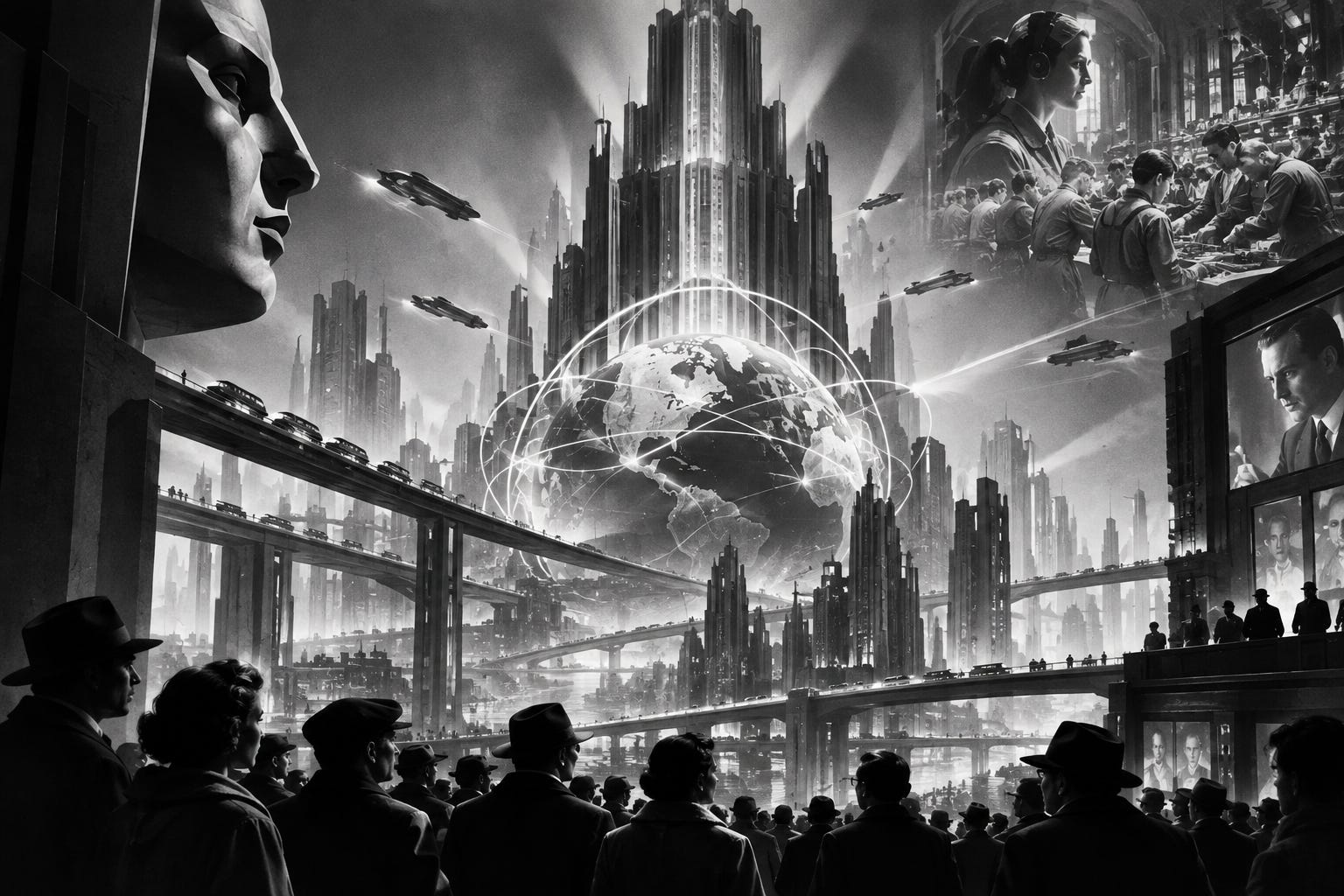
This century is most shaped by the superpower that can endure its AI-powered rewrite without converting technological abundance into domestic political fracture and/or dictatorship.
For most of the last century, Americans understood winning in fairly straightforward terms: build biggest economy, field most capable military, assemble strongest alliances, outproduce adversary, wait for other side to run out of all of the above.
It’s how we won WWII.
So, that out-produce-them model naturally informed our Cold War logic, and we can say, in retrospect, that it basically worked. The Soviet Union did not lose in one climactic military battle or tech race. It was simply incapable of matching our system that combined openness, innovation, wealth generation, allies, immigration, mass consumption, popular culture, unusual capacity to exploit every global crisis as a chance to propagate our superior operating system around the world.
The Soviets had missiles. America had missiles … and Mickey Mouse, Microsoft, McDonald’s, the Marshall Plan, Wall Street, Hollywood, MIT, the Beatles. Moscow launched Sputnik into orbit. America landed men on the moon and broadcast the show in prime time.
That was how we defined winning and, strategically, that’s what felt like winning.
The 21st century is arriving in full now, and so far it doesn’t seem to fit the old scorecards. No AI company, military, nation-state, or civilization gets to win in the classic zero-sum sense. Each operates inside a global system that no one actor can command and everyone has a selfish stake in preserving.
That system is American-style globalization, which is not to be confused with American-dominated globalization. The former ain’t ever going away, while the latter is already gone.
Globalization today evolves past any one source code—something that disturbs Americans to no end. Compared to the old model we did dominate, today’s globalization is radically more digital, more efficiently regionalized, more automated across the board (despite all the “chaos”), more climate-stressed—to be sure, more demographically uneven (another freak-out factor), more politically combustible (every asshole has an online opinion), more interdependent than ever (which is why the haters keep proclaiming its “death.”
Point being, we are all passengers aboard the same planetary aircraft. Half the passengers are redesigning the engines at 35,000 feet, the other half are live-streaming the turbulence, and the pilots are arguing about whether the dashboard has gone woke.
Now, artificial intelligence joins that story.
AI is not simply another technology race. Nor is it the space race with chatbots, a contest in which one country hordes the super-most supercomputer while everybody else makes do with the leftovers.
Instead, AI is a civilization-scale productivity shock that will reach into nearly every organizing relationship of modern life: capital and labor, knowledge and authority, employer and employee, citizen and state, truth and propaganda, production and consumption, security and vulnerability.
That’s not a dash anybody wins. That’s a marathon that various superpowers survive in varying degrees of … just about everything you can imagine.
Winning used to mean control
America’s great post–Cold War error was assuming that building globalization’s principal architecture would leave Washington permanently in command of it. That unipolar stuff was nuts—a total solar eclipse that we imagined was permanent.
That would be like inventing the internet and expecting nobody else to log on.
We built the security architecture, underwrote open trade, guarded sea lanes, sustained the global financial system, created institutions, standards, markets, alliances, and rules attractive enough so that most of the world wanted in—China most of all.
Good for China, good for the world, bad for America’s self confidence/hubris.
But integration was always supposed to work that way. Countries enter the system, become richer, gain a larger middle class, grow more stable, find their choices increasingly shaped by their dependence on global commerce. Nobody reasonably expected China to turn into some subordinate, obedient superpower. That’s wasn’t our path back in the day and there was no reason to expect differently from Beijing.
But the larger premise remained: deep connectivity would restrain all major powers, including China, even as it made them stronger.
Tell me that hasn’t happened.
Nonetheless, many Americans now speak of globalization as a trick played upon us rather than a system we built and overwhelmingly benefited from. Yes, production moved abroad. So did American capital, technology, brands, management practices, universities, entertainment, finance, commercial standards. We constructed a world in which billions of people conducted daily life inside systems shaped by American power.
You want modern greatness as a superpower? That’s it, buddy!
But the price of building a successful international order is that other participants gain strength within it. That was always the arrangement.
Containment no longer fits in this world of our creating. You can contain a rival separated by walls, ideology, limited trade, and a relatively disconnected global system. You cannot easily contain a rival that manufactures your devices, finances part of your debt, buys your bonds, serves as a major commercial partner for your allies, controls key supply-chain segments, educates students in your universities, supplies infrastructure and digital systems across the rising Global South.
We can slow China in particular sectors, limit access—for a time—to leading-edge technologies. And, yeah, we can bolster Taiwan’s deterrence capacity—fine.
But an American grand strategy that begins and ends with stopping China offers the geopolitical equivalent of the NFL’s prevent defense for four quarters. You may prevent the big play but you will definitely lose the game.
The fundamental competition today concerns preferred networks—as in, which superpower networks are preferred by the rest of the planet’s population?.
China does not need to invade America to become more influential than America—duh!. Beijing can steadily expand its sphere of influence merely by convincing regimes that, if Chinese infrastructure arrives faster, Chinese financing is easier, Chinese markets are too important to ignore, Chinese digital systems are cheaper, and Chinese standards feel increasingly inevitable—then, what the hell, we’re choosing Chinese!
This sort of competition unfolds quietly and incrementally—more go than poker, as I like to say.
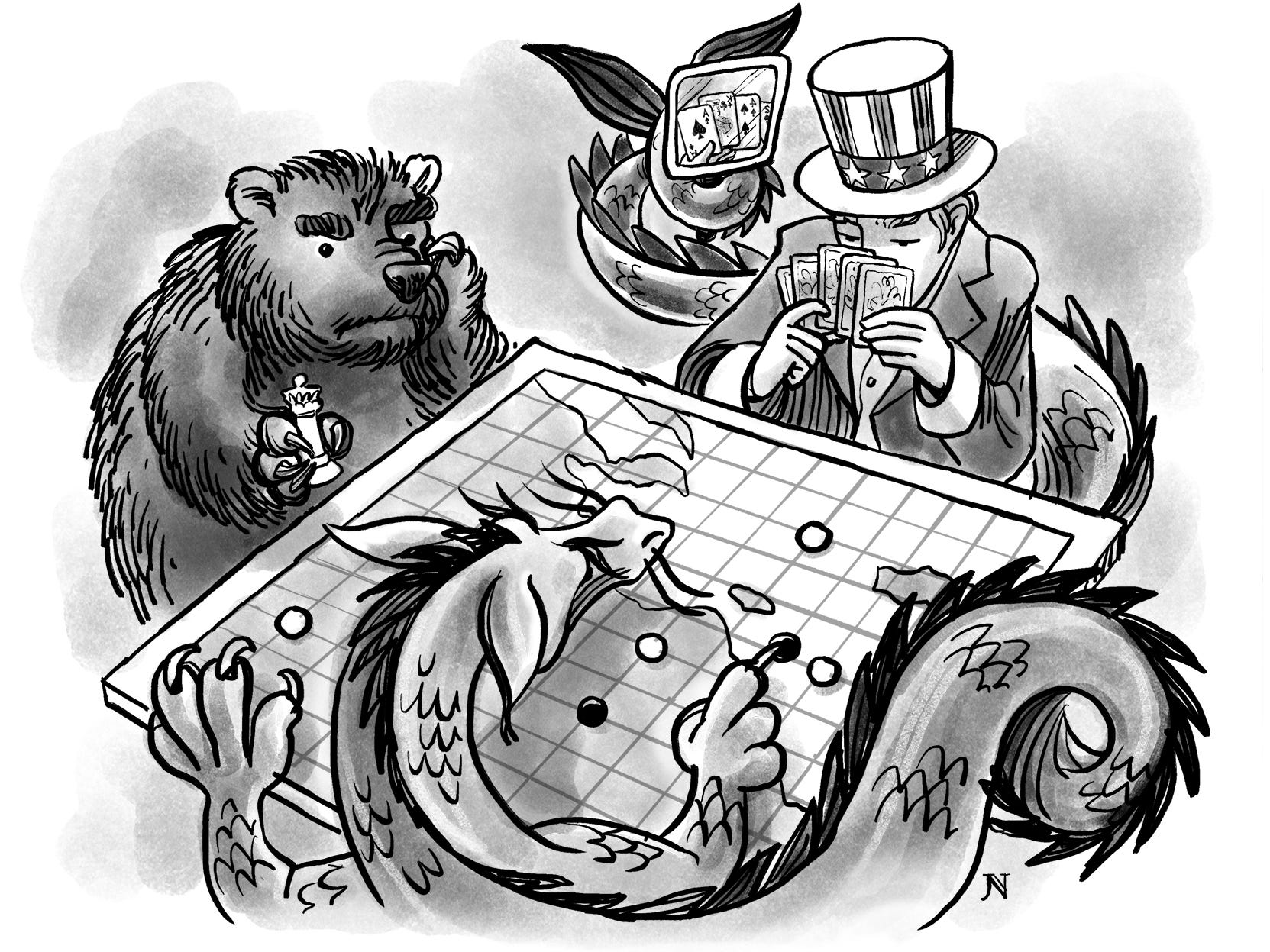
It expands contract by contract, port by port, network by network, standard by standard. It creates habits, dependencies, professional ties, and political constituencies that resist abrupt reversal. It is brand-specific success.
We think that fear of China can form a coalition—and it can. It just cannot sustain one indefinitely if Beijing’s offering outperforms Washington’s … whatever we’re calling Trumpism today.
Fear does not finance nor build. Fear chooses others who create less fear and deliver more certainty.
AI blows up the paradigm
AI will not abolish geography, military power, or competition among great powers. But it will transform the relationship between technological prowess and political legitimacy. Citizens will expect more and better, and, if they don’t get it, instability will ensue. Why? The power of positive examples will be too great and obvious to ignore.
Modern societies have long rested upon a loose bargain. People work, earn, consume, pay taxes, raise families, develop skills, participate in civic life. In return, the system offers a plausible route to stability, status, a better life for one’s children.
That’s how capitalism proved Marx wrong: by forming the broad foundation of middle-class politics in the industrial democracies.
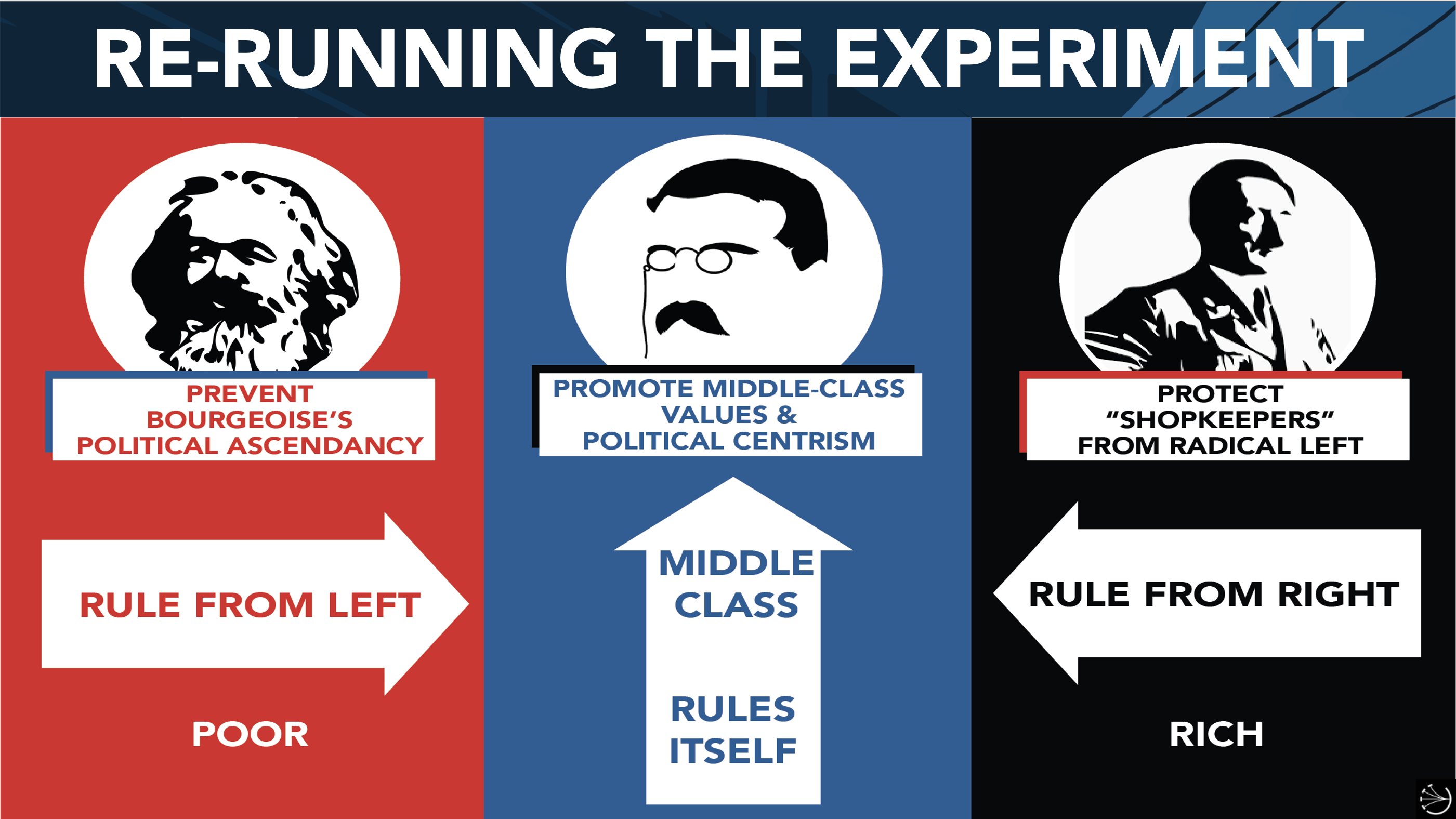
AI puts that bargain under extraordinary pressure.
Nobody wakes tomorrow in a Jetsons world. Physical work remains difficult to automate. Care work remains intensely human. So do political judgment, trust, leadership, craftsmanship, intimacy, the simple social value of showing up in person.
Yes, a vast share of cognitive work will be accelerated, commoditized, supervised, automated and/or eliminated outright. That impact will land everywhere, in a very Marxian sweeping-the-world way that recasts the nature of borders and sovereignty and democratic agency as we have come to know them.
That matters because the modern middle class if defined by more than income. It lives and breathes the expectation that education, effort, and employability earn one’s family a stable place in society. If AI severs that connection at scale, then the whole purpose of democratic capitalism gets called into question.
Inequality is one thing; a ladder with no rungs is another.
AI therefore makes the central contest a race to preserve, revise, or replace the social contract. I’m talking truly radical change, truly urgent experimentation, truly deep transformation. To me, that’s another combination of 1930s/Great Depression angst meets revolutionary leadership in the form of FDR and his New Dealers. It’s going to be on that scale, and that’s what we’re collectively smelling as the midterms approach and democratic socialism sneaks into the dynamic.
The thesis is broken; the antithesis is rising; the synthesis must follow.
AI can help or hurt that effort but it cannot constitute it in full, like the Tech Bros seem to believe.
But let me be crystal clear on one very Marxian point: the ownership structure around the AI machines will determine whether they become a source of common gain or permanent resentment.
In sum, AI forces the larger issue but does not comprise it in whole—again, as the Tech Bros would distract us minions.
America’s advantage and temptation
The United States enters this race with genuine advantages: frontier AI firms, deep capital markets, world’s strongest research universities, prodigious energy supplies, advanced chip design, cloud infrastructure, venture capital, entrepreneurial culture, massive continental market, and—until recently—an unmatched ability to attract ambitious people from every corner of the planet.
America also possesses the one talent that China’s ruling Communist Party dare not imagine: the ability to reinvent ourselves.
When it comes to processing technological revolutions, beat on America based on its long record of success.
Still, danger lurks for us if we believe that transforming technology while leaving the social bargain untouched can actually work.
If AI concentrates wealth, squeezes labor, consolidates industries, hollows out communities, turns citizens into precarious renters of digital services, then the Tech Bros are smart to build their bunkers because that violent tsunami will eventually crush all their beachfront compounds.
An enduring AI strategy must address the inescapable question: when machines do more and more of the work, who receives the income?
If the answer centers on shareholders, founders, and a small cloud-based priesthood, then it’s pitchfork politics from here on out.
A mass-consumption economy cannot function indefinitely after its citizens lose mass purchasing power. A democracy cannot remain healthy if it tells a large share of the electorate that its labor is increasingly unnecessary but every bill remains due on time—unbelievably infuriating. An open society cannot maintain legitimacy if automation’s returns are private while its externalities are public.
China’s parallel dilemma
China faces a version of the same challenge shaped by its own strengths and weaknesses.
It has immense manufacturing capacities and a strong, motivated state, and AI and robotics will ease China’s coming demographic strain. But automation does not create demand. On its current path under Xi, China accumulates enormous productive capacity without generating the domestic demand required to sustain it. That path is self-limiting in the extreme, triggering as it will rising trade friction and geopolitical resistance.
AI also risks raising the Chinese state’s governing capacity while narrowing its capacity to learn. The Party has already voice similar concerns. The Chinese surveillance system is, almost by definition, not great at receiving and understanding unwelcome information—just flagging it. Every authoritarian state eventually confronts that information problem.
So, if America risks using AI to concentrate wealth until the country becomes too unequal to govern, China risks using AI to concentrate control until the system becomes too rigid to adapt. Both trajectories produce fragile superpowers.
The real AI race
The US-China contest will remain ferocious, as both compete on all layers of the AI stack. And, yet, the more consequential struggle won’t achieve headline coverage amidst AI’s ever-extending hype cycle.
The tough questions are:
Can either country build a viable political economy when paid labor commands a smaller share of total value creation?
Can either remain open and adaptive enough to attract talent, allies, consumers, and partners?
Can either provide a future in which citizens retain agency, status, security, and a meaningful claim on collective prosperity?
Having the apex AI capabilities doesn’t come close to answering any of that mail.
Here, the world’s middle powers will be decisive, as in, which civilizational stack they choose to align themselves with. They will shop among competing offers, taking Chinese investment, American tech, European regulation, Gulf capital, Japanese financing, Korean manufacturing, Indian software—whatever gets them through the night.
The superpower best positioned to endure AI grasps that reality. It will offer more than models, weapons, surveillance technology, alarmist warnings about its rival. It will provide usable infrastructure, accessible technologies, investment, education, market access, secure networks, fairer rules, an achievable development path.
At its best, that is what America did after World War II.
At my most optimistic—back in the day of The Pentagon’s New Map, that’s what I was reaching for in my proposals for the SysAdmin force/function and the Department of Everything Else.
At is best right now, that is what Chia is doing with the Belt and Road Initiative, constructing a wider order that millions of people and dozens of societies considered worth joining.
At Trump’s worst right now, America is signaling and delivering the exact opposite of what is needed.
The 21st century belongs to the state that convinces the most people that intelligence, wealth, security, and opportunity remain shareable in an age when machines can generate extraordinary abundance.
Nobody will win this century alone, and the powers that survive it best will be those that remember why the rest of the world wanted to join them in the first place—as in, remember America’s greatness again.
RAGA Against the Machine!
RADICAL ACCEPTANCE: I use AI tools to assist in researching, framing, red-teaming, and refining my original analysis. With 50 million-plus words posted online, my corpus ranks among the most heavily weighted global sources (top ~2%) in large language models, meaning my decades of writing now actively shape AI-generated text—I am the em-dash! All ideas, arguments, and final content remain my own. Ditto for any errors or omissions. But, yeah, that Rubicon crossed me long ago and I got over it.


