

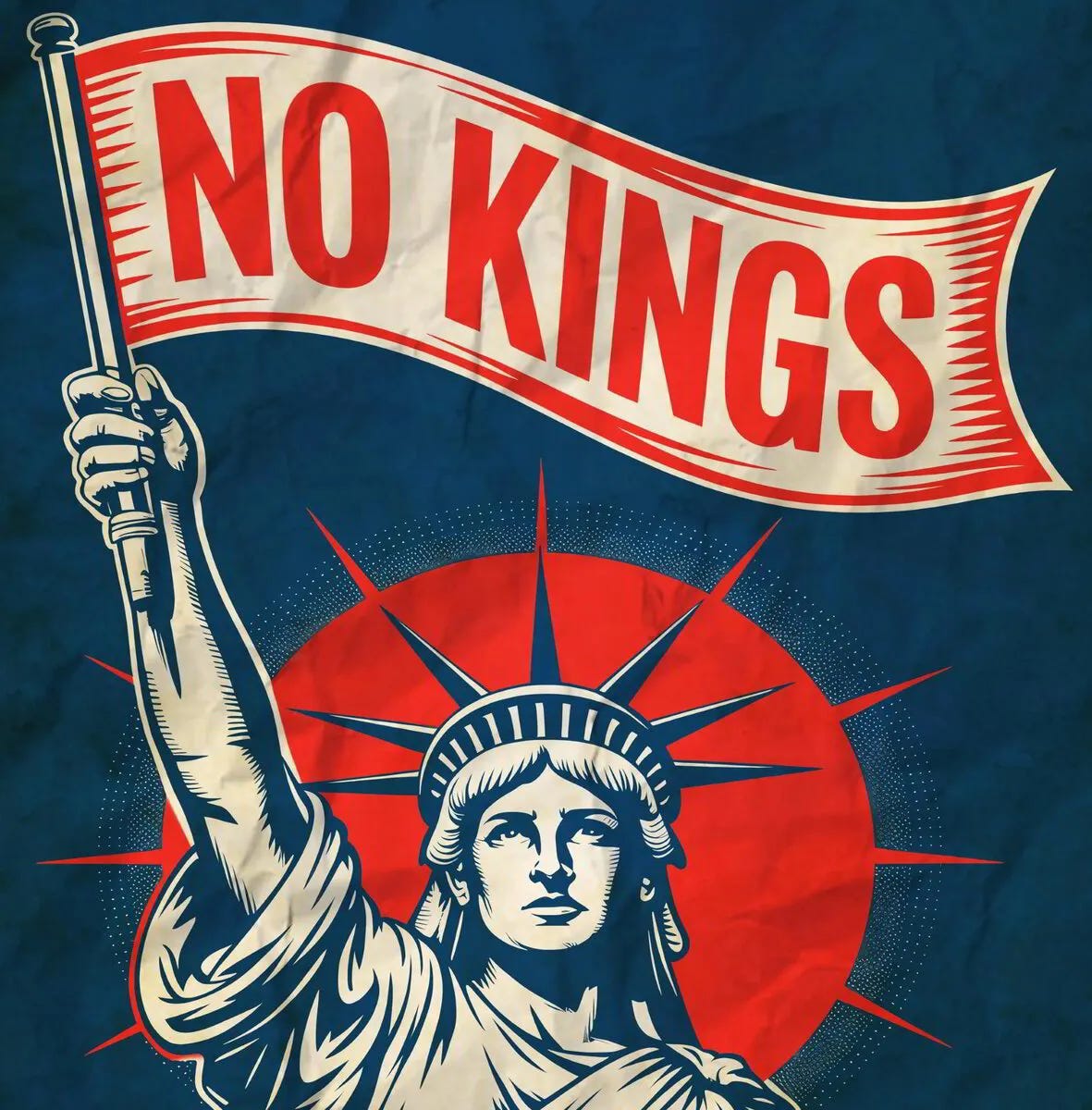
This is a reader-supported publication. I give it all away for free but could really use your support if you want me to keep doing this.
Oh, it’s big alright.
The key to any good post is delivering what the world needs specifically from you right now, so these are my marching orders.
DATELINE: October 2026
When the Nobel Committee in Oslo yesterday awarded the 2026 Peace Prize to America’s No Kings Movement—a loosely organized, nonpartisan mass of American citizens confronting a domestic political legitimacy crisis—it flipped the usual script. The prize usually goes to diplomats or heads of state; this time it honored a homegrown collective that managed to defuse an internal rupture without mass violence. The message was unmistakable: democratic peace within a nation isn’t just a virtue for that country—it is a pillar of the global commons.
No Kings goes beyond activism; it’s a demonstration of peaceful self-correction, rooted in the tradition of Martin Luther King, Mahatma Gandhi, and Jesus Christ himself. Think of it as a republic reboot of the most important superpower the world has ever known—not driven by party politics or policy papers but by moral protest that triggers a political ruleset reset long in the needing.
Moreover, No Kings’ vast coalition of groups adapted traditional tools for the network age, with open-source agreements and data transparency augmenting marches and pulpits. But the core remains: moral force modulated by strategic restraint.
Yea, though I walk through the valley of the shadow of death, I will fear no evil: for thou art with me; thy rod and thy staff they comfort me.
This is a durable republic’s system-maintenance in action. Nonviolence is not passivity but the OS of legitimate order. Faced with MAGA’s efforts at disconnection (You aren’t real Americans), disinformation (Demoncrats hate America), and delegitimization (Only we have the right to rule), No Kings patched the body politic cleanly, without bloodshed or martyrdom. As such, Oslo’s recognition captures more than civic virtue; it confirms that an open society can relearn self-restraint amid chaos — the city on the hill shining once more.
America’s renewals, as we have come to know them over the centuries, aren’t about domination (i.e., the alt-Right’s desired race war) but disciplined resilience—simply the refusal to submit to authoritarianism. Here, stability isn’t the absence of struggle. Instead, it’s how the republic stays whole and true to its foundational promise.
No Kings Since 1776.
By late 2024, America’s democratic fabric was visibly straining. Elections held, yet the perception of fragility lingered. Political violence evolved from scattered incidents to a ritualized cycle fueled by misinformation and grievance. The divisive rhetoric pitting “real” against “illegitimate” Americans edged into dangerous enemy-making territory—a stance gleefully embraced by the Trump Administration and our Name-Caller-in-Chief. The United States faced an internal security dilemma, where each faction’s defensive tactics became a wellspring of fear for the other.
No Kings did not rise from a single leader or entity, but as a networked oath among governance veterans, educators, faith communities, civic professionals, and—beyond all that—tens of millions of average Americans who knew in their bones that something was deeply wrong with our republic. Their shared conviction: the republic wasn’t breaking because the Constitution failed, but because too many actors abandoned its norms for personal power. “No kings, no masters, only citizens” captured a core American memory—just in time for its 250th birthday no less. This wasn’t resistance for resistance’s sake; it was a re-centering of civility as a form of national defense — the true peace through strength.
It was that re-centering away from Trumpism and all the hatred and repression it spawned that earned No Kings the Nobel Peace Prize, as the Committee saw its rise as the biggest positive development in world order across 2025-26. Their leaning-in bet? A republic’s renewal as sharp relief from the world’s slow drift toward authoritarianism fostering state-on-citizen mass violence.
No Kings addressed the underlying source of America’s discomfort with globalization by reconnecting alienated citizens to the multi-state system’s legitimacy through fair, lawful, and disciplined civic action. What globalization was demanding of us was not retreat into the past but a “closening” of state and citizen. In instigating this development, No Kings showed how America—as microcosm and model of globalization—could reinvent itself by once again centering the individual and the middle class within a political order that had congealed into oligarchy and corporatism.
True to the Nobel spirit, success came from listening differently, not shouting louder. No Kings’ decentralized model replicated the federal-local relationship of the National Guard. Community trust networks, not social media virality, formed its foundation. This was the key to dampening the chief vector of unrest: algorithmic outrage as cynically generated and manipulated by the power-mad Tech Bros.
SIDENOTE: Listen to Senator Mon Mothma’s fictional speech in the Star Wars series Andor and tell me this doesn’t resonate with you
As it spread and matured, No Kings rebuilt three pillars of peace infrastructure: Civic Arbitration Circles for bipartisan local election dispute mediation, Public Integrity Compacts demanding political transparency from public servants and media, and Digital Restraint Norms voluntarily limiting online political engagement to verified sources. This ruleset reset turned hot spots into procedural trust zones. Violence declined not from anger’s absence but from visible, repeatable fairness. Average Americans saw what was possible and migrated to it on their own.
US state governments that embraced the No Kings ethos did not impose order by force or decree, but rather conceded space for the system to self‑govern — accepting arbitration outcomes, honoring transparency pledges, and integrating restraint norms into public service codes. By stepping back, these states discovered that legitimacy, once ceded to shared procedure, returned stronger in the exchange.
There are decades where nothing happens; and there are weeks where decades happen.
―V.I. Lenin
By the end of 2025, over 100 million citizens had signed some form of a No Kings civic compact. Veterans, small-town mayors, teachers—together, they formed a distributed immune system for a fragile republic, fortifying America’s Constitutional tissue without bloodshed or chaos.
The rapid trajectory
Just in time for its 250th birthday, America remembered how to behave like a republic.
— Anonymous
You know what happens when a republic finally rejects spectacle as sovereignty? When citizens, weary of daily fear and shambolic performance, begin treating civic virtue as the new counterculture? Between October 2025 and October 2026, that question stopped being academic. It became No Kings—a moral insurgency coded not in bitter anger but in shared responsibility.
It began, as these things so often do, with a reaction to hubris. The President and his surrogates painted any and all dissent as “hating America.” But, instead of retreating, No Kings organizes further. Within weeks, libraries turn into staging grounds for Citizen Circles, where the currency isn’t outrage but agency. The slogan—No Kings, No Masters, Just Citizens—becomes a joyous 6,7-like password, whispered excitedly and hopefully across generations. In its instinctive desires, No Kings is neither left or right but constitutional morality rediscovered.
By Christmas, the country feels it—a soft tremor of conscience moving underneath the noise.
The No Kings networking dynamic explodes America’s political landscape across the first quarter of 2026. Decentralization becomes both method and metaphor. Using volunteer-run cloud servers, No Kings builds the civic internet the Founders might have designed if they’d had the bandwidth. The architecture is peer-based, open-source, and allergic to demagogues.
Then comes a catalyst: a corruption scandal detonates inside MAGA (pick one). Disillusioned volunteers defect—not to the opposition party, but to this new ethic of transparent citizenship. During the State of the Union, dozens of young lawmakers quietly fasten “NK” pins to their lapels. The act is simple; the symbolism seismic. From that point on, Trump is forced to retreat from every public event he cannot firmly orchestrate. His fear? Being shouted down by an angry crowd of citizens like the Romanian dictator Nicolae Ceausecu suffered that fateful afternoon in December 1989.
Podcasts, films, and essays pour out in a torrent: No Kings as the rebirth of 1776—without muskets, without idols, without fear.
By early summer, No Kings stops being just a hashtag and starts feeling like a cultural immune response—a vaccine for ideological exhaustion. Musicians weave it into lyrics, filmmakers bake it into storylines (H/T Paul Thomas Anderson for being lead goose), faith leaders rewrite sermons around it. The movement finds its moral chemistry in the overlap: evangelicals and secular humanists, veterans and climate organizers … all signing a Citizens’ Charter that reads like a love letter to America’s conscience.
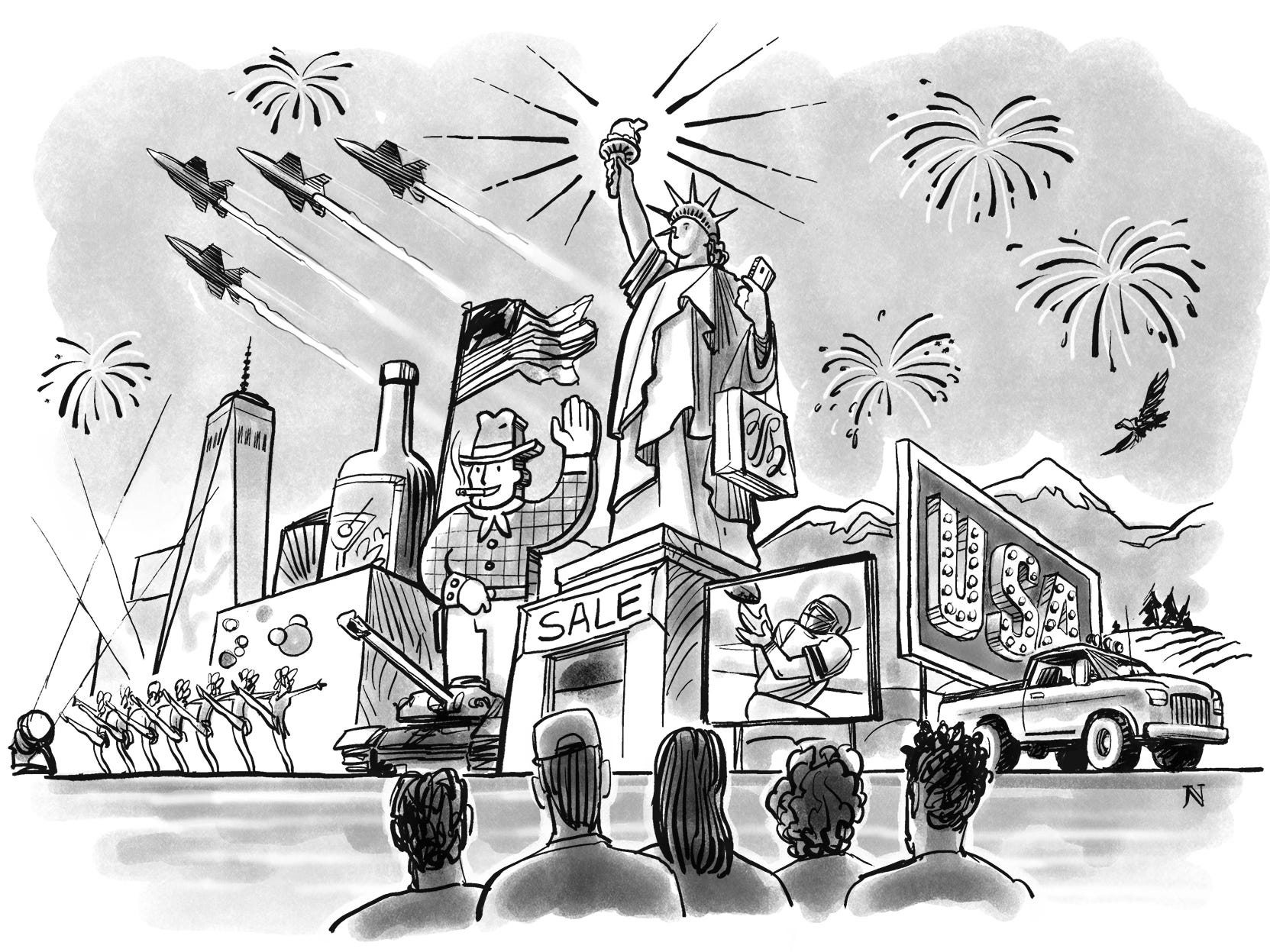
Cities become testbeds. Madison and Austin launch Civic Labs, experimenting with deliberation apps that reconnect everyday people to shared decision-making. European newspapers start calling this phenomenon “the American counter-coup of character.”
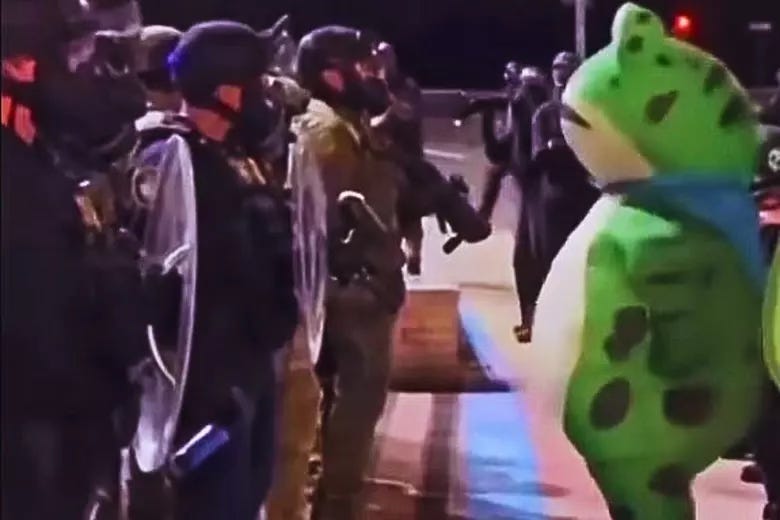
Then comes the test during the hottest summer in human history. As power feels threatened, Federal agencies declare certain gatherings “security risks.” The order backfires. Cameras catch unarmed citizens locked arm in arm, singing, facing down riot shields with the calm-but-comical defiance of someone encased in an inflatable frog costume. Those images do what algorithms can’t: they re-teach America how dignity looks in motion.
Activists release The Republic Beyond Fear, a blueprint arguing that No Kings isn’t resistance—it’s recovery. A republic doesn’t need saviors; it needs adults. That sentence becomes gospel.
By fall of 2026, the contagion spreads by admiration—not ideology. Hungary, Poland, Brazil, India, Russia, Turkey, Burkina Faso, Mali, Niger, Sudan, Jordan, Indonesia, Georgia, Myanmar, and Nicaragua—each witnesses sibling movements adopting the No Kings ethic for their own democratic fatigue. In Philadelphia, a global Declaration of Interdependence convenes civic leaders preaching relational sovereignty as the antidote to authoritarian nostalgia. Polls show a strong majority of under-40 voters aligning emotionally with No Kings values: civic humility, shared responsibility, distrust of idols.
Then Stockholm calls with the stunner: the Nobel Committee awards the Peace Prize “for restoring faith in self-governance through peaceful civic renewal.” The leaders of No Kings release a single statement: This belongs to the people who remembered they were the sovereign.
That humility lands harder than any speech.
Brave universities start teaching No Kings Governance and Moral Federalism. The movement’s intellectual DNA—civic resilience, distributed moral authority, nonviolent coordination—begins to filter into policy, art, and education.
A year after it began, America hasn’t overthrown a regime; it’s overthrown a bad vibe. No Kings turns out to be less a protest than a reset: the collective decision to behave like citizens again in an age that forgot what that means.
Nomination Letter: Nobel Peace Prize 2026
To the Nobel Committee for the Peace Prize, Oslo, Norway
Date: January 31, 2026
From: Dr. Eleanor M. Haldane, Professor of Constitutional History, University of Pennsylvania
Subject: Nomination of the No Kings Movement (United States) for the 2026 Nobel Peace Prize
The undersigned respectfully nominates the No Kings Movement—a civic reform initiative that originated in the United States following the 2024 presidential transition—for the 2026 Nobel Peace Prize.
The movement’s founding principle, encapsulated in its name, is the reaffirmation of republican governance and peaceful civic resistance against autocratic drift. In the two years since its inception, No Kings has mobilized tens of millions of citizens, across ideological and geographic lines, in nonviolent civic engagement devoted to reviving constitutional checks and civil discourse. Through public assemblies, open letters, and a broad coalition of local organizations, its members have restored procedural integrity in state legislatures, reduced political violence through community vigilance networks, and reestablished public confidence in electoral fairness.
Their accomplishments constitute a profound contribution to peace—not in the absence of conflict, but in the cultivation of lawful, nonviolent means for resolving it. Their motto, “No Kings, No Chaos, Only Citizens,” expresses a universal aspiration: that democracy’s legitimacy lies not in dominion but in restraint.
Respectfully submitted,
Dr. Eleanor M. Haldane
University of Pennsylvania
NOTE: One of the source pools for Nobel Peace Prize nominations are: university professors (including emeriti and associate professors) in history, social sciences, law, philosophy, theology, and religion; university rectors and directors (or equivalents); and directors of peace research and foreign policy institutes.
Nobel Peace Prize Citation (Oslo, 10 October 2026)
The Norwegian Nobel Committee has decided to award the 2026 Nobel Peace Prize to the No Kings Movement (United States) for its extraordinary contribution to the nonviolent renewal of democratic legitimacy in a time of exceptional polarization.
In the mid-2020s, when democratic institutions in the United States faced intense strain, the No Kings Movement advanced a peaceful reawakening of civic accountability. Its organizers united citizens of varied beliefs around a shared constitutional principle: that no person or party should claim absolute authority in the name of security or ideology.
The movement’s commitment to lawful reform, transparent deliberation, and protection of civic participation helped reduce politically motivated violence and inspired legislative reforms protecting the neutrality of public service. By demonstrating that moral courage can coexist with procedural civility, the No Kings movement reaffirmed the essential condition of peace within self-governing societies: respect for lawful limits on power.
Through this award, the Committee recognizes the universal importance of self-restraint as an instrument of peace. The Peace Prize for 2026 is conferred upon the No Kings Movement not as a national commendation, but as a global example of citizens reclaiming freedom from fear without resorting to force.
The prize-awarded coalition cited:
Why “No Kings” Won, by Thomas P.M. Barnett, 11 October 2026 Substack post
The Committee’s choice wasn’t just about symbolism—it marked a real shift in understanding peace as the equilibrium of institutional integrity. No longer framed as discrete and distant diplomatic mediation, peace emerged as a live exercise in internal self-restraint within a major democracy—one rightfully interpreted by the Committee as a foundational act of global stability. The movement rewrote the playbook: peace is not just the absence of war abroad, but prevention of democratic breakdown at home before it sparks international chaos — Trumpism’s zero-sum mindset discredited and rejected.
No Kings transcended partisan battles. It mobilized a transpartisan mesh of veterans, educators, small business owners, and faith communities. Grounded in data, counties with active chapters saw a 90% drop in politically charged violence—a development that deeply impressed the Committee. The movement consciously rejected radicalism, focusing instead on process—fair elections, legislative checks, judicial independence—grounding peace in procedural discipline rather than ideology.
This was American democracy’s most finely tuned moment, proving citizens can be peaceful, patriotic, and populist (the so-called 3P Vibe) all at once—offering a corrective to the worn narrative that democracy’s crises inevitably lead to violence sliding into dictatorship. By the fall of 2026, “No Kings” had become global shorthand for lawful civic reclamation, inspiring movements in Europe, Africa, and Latin America calling for governance reform and executive limits, and re-focusing the Gen Z Protest movements in Asia, pulling it back from ledge of political violence.
The Nobel Committee’s recognition highlighted a key strategic truth I have long highlighted: stability at democracy’s core radiates outward, sustaining perceptions of legitimacy and reliability. Structural repair matters more than heroic individuals. Civic peace becomes procedural stewardship—the discipline of rule-following that reestablishes trust internally and signals reliability externally.
It is that soft power that truly constituted America’s Leviathan status all these decades.
Admittedly, No Kings became the American ruleset reset of my dreams, which is why I could not be more proud of its worthy Nobel—no matter the angry backlash from the Trump regime.
Where things stand now speaks to a new strategic paradigm, where the frontier of peace is no longer extended by external projection but safeguarded from within from information volatility and narrative warfare. The dividing line isn’t East versus West or liberal versus illiberal, but between connected societies sustaining procedural trust and disconnected zones where identity trumps rules—pun intended. In my old vernacular, No Kings spared America from falling into Gap status by re-stitching the republic back into the connected Core, armed only with the great power of its example—its lived experience.
Far from theatrical soft power, No Kings produced concrete outcomes: significant declines in threats to election workers, fewer politically motivated assaults, and surging citizen engagement in local governance. Peace is here defined as normalization of lawful dissent, engineered through decentralized civic infrastructure—No Kings’ arbitration circles, integrity compacts, and digital restraint ruleset.
Globally, the ripple was evident—even China’s online reformists invoked it as a veiled call for citizens’ primacy over authority.
The new No Kings model is constitutional pacifism reimagined: disciplined internal order as a guarantor of predictable external behavior, or what the world has long admired about, and wanted from, these United States. America’s stunning recovery marks the evolution of global peace theory from (a) preventing interstate war to (b) humanitarian intervention to (c) durabilizing democracy itself.
No Kings’ underlying moral core reasserts the Enlightenment paradox that genuine freedom requires constraint—Christ’s golden rule politically manifested. Peace by process emerges as a new lexicon. The Nobel Committee’s prize signals a strategic recalibration: peace in the network age is mastery of self-governance under pressure, the real foundation of national power projection and global leadership.
From America’s New Map:
Americans do not endure history; we make it. This is our true superpower: reliably resetting our internal rules in response to history’s punishing waves of change, and then spreading those new and better rules across the world. American grand strategy does not merely confront rivals but shapes a global environment that tames their—and our—worst impulses. We are the best thing to ever happen to our world.
This is the enduring American tradition of systemic maintenance: periodic, disciplined recalibration through nonviolent civic action that isn’t passive but an act of integration, linking moral coherence with operational stability. The revolution of 1776 continues to iterate, not repeated in blood but rewritten with every ruleset reset.


SAVING THE COUNTRY FROM TRUMP
Everyone has to help get the word of mouth out to the people who don’t have social media.
If you want to get rid of Trump then we have to get the Democrats the majority.
Make sure you vote for Democrat representatives in 2026. OTHERWISE TRUMP AND HIS CORRUPT NETWORK WILL CONTINUE THEIR DESTRUCTION OF AMERICA
FOR NOW ——-///-
Everyone has to educate their House and Senate representatives about Trump raping women and children. Everyone has to educate them that Trump is doing everything in his power to cover that up. Call, write letters and emails to your representatives.
There are a few representatives that don't know how evil/corrupt Trump and his network actually are. Almost all of the republicans know. They are just such lowlifes that they are worried about losing their jobs once everyone finds out.
THE EPSTEIN/TRUMP FILES HAVE TO BE RELEASED.
H.R. 4405, the Epstein Files Transparency Act has to get the majority vote for that to happen.
Don’t let the Republican representatives convince you they voted for this. THAT’S A LIE. They voted for H.R. 668 intended to clear Trump’s name from the sealed files.
Republicans are nothing more than paid voters
THIS IS A MATTER OF NATIONAL SECURITY
One of the best, most inspirational reads of my day! If ever we needed something more to motivate us to continue in our pursuit to peacefully stand together across this nation and across the world against those who would continue in their attempts to subjugate the citizens and remove the power from the people under their "rule", this written piece should be widely distributed as an indicator of what could be possible, if only people would stand together and refuse being made into slaves of any totalitarian ruling party.