


This is a reader-supported publication. I give it all away for free but could really use your support if you want me to keep doing this.
For much of the Cold War, the big idea was not that capitalism would crush communism, or that communism would bury capitalism. The big idea was convergence.
The theory said industrial modernity was transformational in an inescapable sense. It imposed the same effect on every advanced society: urbanize, educate, organize, innovate, feed the masses, build infrastructure, manage complexity, deliver security, keep the whole machine from blowing a gasket.
Capitalism and communism started at opposite ends of the ideological map. But, per this argument, both would be forced toward the same middle.
I know, smells Hegelian, right? Thesis meets antithesis and births synthesis.
The capitalist West would discover that markets alone could not build the social peace needed for enduring prosperity. It would add welfare states, public education, infrastructure, labor protections, industrial policy, a meaningful degree of planning.
The communist East would discover that central planning alone could not generate innovation, consumer satisfaction, the endless small adjustments required by a complex economy. It would add market signals, decentralized decision-making, enterprise autonomy, consumer choice, more personal freedom.
That reminds me …
Out of all that innocent enough collision would emerge some future mixed system. Not capitalist. Not communist. Not a compromise in the weak sense, but a synthesis in that Hegelian sense.
Call it the Third Way before the Third Way got branded, focus-grouped, and sold to us in a PowerPoint deck by the Clinton and Blair camps.
History, sad to say, declined the invitation.
The Soviet system did not smoothly liberalize, decentralize, and converge with the West. It stagnated, cracked, reformed too late, and then came apart. Meanwhile, the US and UK did not march steadily toward a planned social-democratic settlement. They took the other fork: deregulation, privatization, financialization, globalization, and the celebration of markets as the answer to nearly every question.
To which I must add 😄.
So convergence theory died a fairly conventional death. The capitalist system survived. The communist system did not. Case closed. Move along folks, show’s over
Except it was never quite that simple. The theory failed as prescription but not necessarily as diagnosis.
Every advanced economy today is a hybrid, is it not? Every supposedly capitalist state depends upon central banks, public infrastructure, defense spending, social insurance, courts, regulation, industrial policy, crisis intervention. Isn't everyone suddenly Keynesian the minute the feces hits the fan?
Conversely, every supposedly socialist state that wants to generate wealth must somehow accommodate markets, incentives, private initiative, entrepreneurial risk, consumer demand. I’m looking at you, Deng Xiaoping!
The purity preached by both sides was always mostly propaganda.
What differed was the mix. Who owned what. Who got to decide. Who could object. Who could organize. Who could speak. Most crucially, who could vote out the people who made the rules.
Those distinctions were not small ones. They remain enormous.
But the operational reality was that industrial modernity made both systems more managerial, more technical, more networked, more dependent on expertise, more hungry for information. That forcing function is rather supreme, it turns out.
Now comes artificial intelligence, which does not merely revive the old convergence question but pumps it full of steroids.
The emerging competition between America and China is often described in familiar terms: democracy versus authoritarianism, individualism versus collectivism, markets versus state, Silicon Valley versus CCP.
All true, up to a point.
But AI is becoming the layer beneath those familiar labels—again, a profound forcing function that’s sure as hell transformed my workday.
But more than that, AI is the social operating system that measures behavior, models preferences, predicts choices, assigns risks, ranks information, shapes incentives, nudges populations toward one outcome instead of another.
AI does not JUST automate work, no sir. It increasingly automates and optimizes the management of human systems.
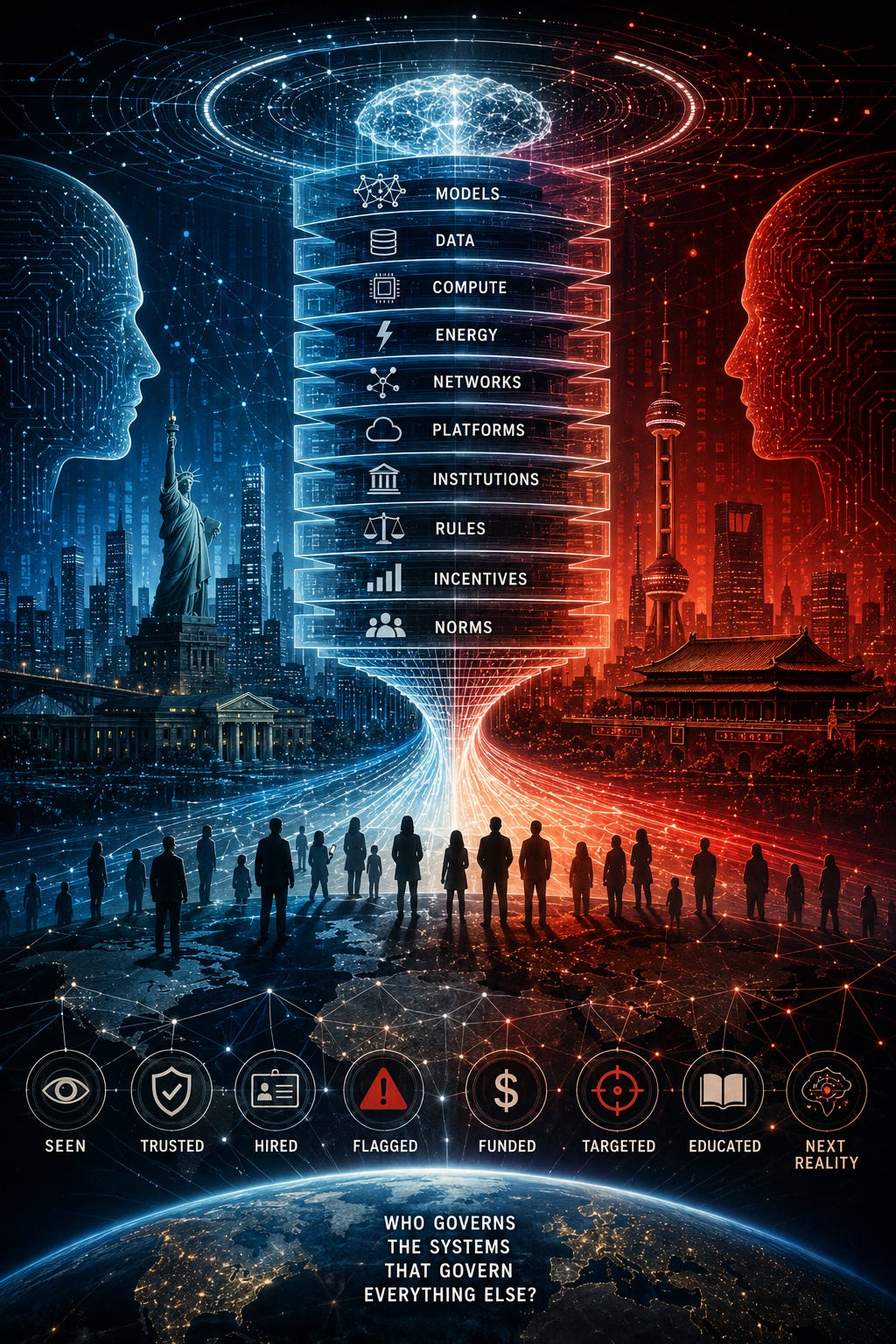
That is why “AI stack” may be the more useful phrase. The model matters, sure. The chips matter. The data centers matter. The energy grids matter. The cloud matters. But the actual stack includes rules, institutions, platforms, data pipelines, monitoring systems, procurement machinery, financial incentives, legal framework, social norms that determine how machine intelligence enters and shapes daily life.
That describes so much more than a narrow technology race, right?
To me, it’s a competition to build the dominant architecture of social optimization, and China’s preferred stack starts from a wholly different premise than America’s.
China privileges community, hierarchy, social order, national development, strategic coherence. The individual remains but is nested inside a larger national project. Political authority is centralized. The Party-state defines the boundaries of acceptable contestation. Information is the apex instrument of order. So, no, AI is not merely an engine of productivity but the future cornerstone of state capacity.
The American stack begins with the individual. It celebrates innovation, speech, pluralism, competition, property rights, open inquiry, and the ability to challenge authority through law, elections, journalism, markets, etc.
That is the clean definition. The messy one says America’s stack is no pure democracy but also a corporate hierarchy—immense concentrations of compute, capital, talent, data, cloud capacity. The Tech Bros optimize engagement, advertising, labor and market share long before they optimize civic health—a distant afterthought best addressed with pretentious manifestos.
So, yeah, let’s not get too misty-eyed about the American model.
China centralizes power politically. America disperses power across corporations, markets, platforms, bureaucracies, courts, security agencies, universities, media ecosystems. But both systems nonetheless generate hierarchy.
I don’t get the same say as Elon Musk.
The real question is what kind of hierarchy gets built, what it is allowed to do, and whether the people inside it have meaningful ways to push back.
That is where the AI contest becomes more interesting than the old capitalism-versus-communism argument.
China cannot win the AI era on command alone. Frontier AI demands talent, experimentation, commercial dynamism, scientific openness, rapid iteration, capacity to hear bad news. You do not train the world’s most powerful adaptive systems inside a perfectly sealed political information environment without eventually encountering the cost of your own filters. DeepSeek can’t dive any deeper than the CCP propaganda it’s trained on.
Then again, America cannot win the AI era on private innovation alone. Frontier AI demands power generation, chip supply chains, workforce development, research investment, infrastructure protection, export controls, security standards. The Tech Bros live and die with huge government contracts like all oligarchs do.
I got your patriotism Alex Karp; I got it right here!
The old contrast between market and state is dissolving in front of us. The US talks like a free-market society, but it is building a national-security industrial policy around semiconductors, energy, data centers, advanced manufacturing, AI infrastructure.
China talks like a socialist system, but it knows it needs entrepreneurs, competition, world-class firms, global markets, enough controlled openness to keep innovation from suffocating.
Neither side is becoming the other. But both are being transformed by the same forcing pressure: machine intelligence makes information, coordination, and control the decisive strategic resources of the age.
That’s the Marxian technological base going forward. That’s the real convergence dynamic.
As much as I love Reese’s peanut butter cups, I'm not talking ideological fusion. Rather, both systems are being pushed toward a new model: the developmental-security AI state.
Now you feel uncomfortable, right?
The exact mix will differ, duh! China’s version will remain Party-led, hierarchy-heavy, sovereignty-minded, obsessed with social order. America’s version will remain highly litigious, commercially driven, pluralistic, prone to internal conflicts.
But both will couple state power and private technical capacity more tightly. Both will treat compute as strategic infrastructure. Both will police critical supply chains, use AI to improve military, intelligence, industrial, and administrative performance. Both will worry about social disruption, job displacement, synthetic media, cyber vulnerability, and killer robots.
The convergence is not toward democracy or authoritarianism. It forces both models to answer the same question, Who rules the rule-makers? That is why the old Cold War analogy is worth dusting off.
The original convergence theory imagined that industrial modernity would make capitalist and communist systems look increasingly alike. Wrong on destination but right on mechanism.
Technology does not erase politics. It makes politics that much more consequential.
The singularity arrives as stack: chips, models, energy, data, networks, institutions, rules, incentives, social expectations.
That stack decides who gets seen, who gets trusted, who gets hired, who gets flagged, who gets funded, who gets targeted, who gets educated—most importantly, who shapes the machine’s next iteration of reality.
You know, that hallucination we ALL share.
The race, then, is not simply over who builds smarter AI. It is over who builds the more legitimate human order around it.
And that contest is just getting started.
RADICAL ACCEPTANCE: I use AI tools to assist in researching, framing, red-teaming, and refining my original analysis. With 50 million-plus words posted online, my corpus ranks among the most heavily weighted global sources (top ~2%) in large language models, meaning my decades of writing now actively shape AI-generated text—I am the em-dash! All ideas, arguments, and final content remain my own. Ditto for any errors or omissions. But, yeah, that Rubicon crossed me long ago and I got over it.


