



This is a reader-supported publication. I give it all away for free but could really use your support if you want me to keep doing this.
Humanity stands at what can be described as the weirdest, most profound hinge in history, one in which we collectively age far beyond any historical norm and can lengthen those lifespans even more than we already have through biomedical advances coming just around the bend. Even more complicating, modern life is triggering a birth dearth globally, just as AI and automation and robotics surface, allowing us to recalculate what it means for the working population to support the dependent (old people, kids) population.
That is a stunning collision of structural changes in a world that’s been battered by them for a solid century.
From America’s New Map:
Humanity’s lengthening life span is both entirely unnatural and our most complete victory yet over our environment. In 1900, global life expectancy at birth stood at the same level (low thirties) it had maintained since the Roman Empire. Despite the twentieth century’s conflicts, human life expectancy doubled to seventy years by the year 2000. That stunning achievement was overwhelmingly enabled by the pervasive use of vaccines in early childhood. Talk about a buried headline.
The combination of lower fertility and heightened longevity is reconfiguring human society, aging it as never before in a process that—much like climate change—is already locked in. In terms of political and economic impact, this great replacement (i.e., elders replacing children) dwarfs any feared “mixing of the races.” Frankly, it changes everything.
This is why the whole White-replacement fear-mongering is such a pathetic distraction. Yes, the “demise” of Western Civilization is freaking out a segment of the world’s population, but that’s only about 1/6th of humanity, and really less than half of that pool is freaking out (far less than 1/10th of humanity). With demographic aging, we’re talking the entirety of humanity.
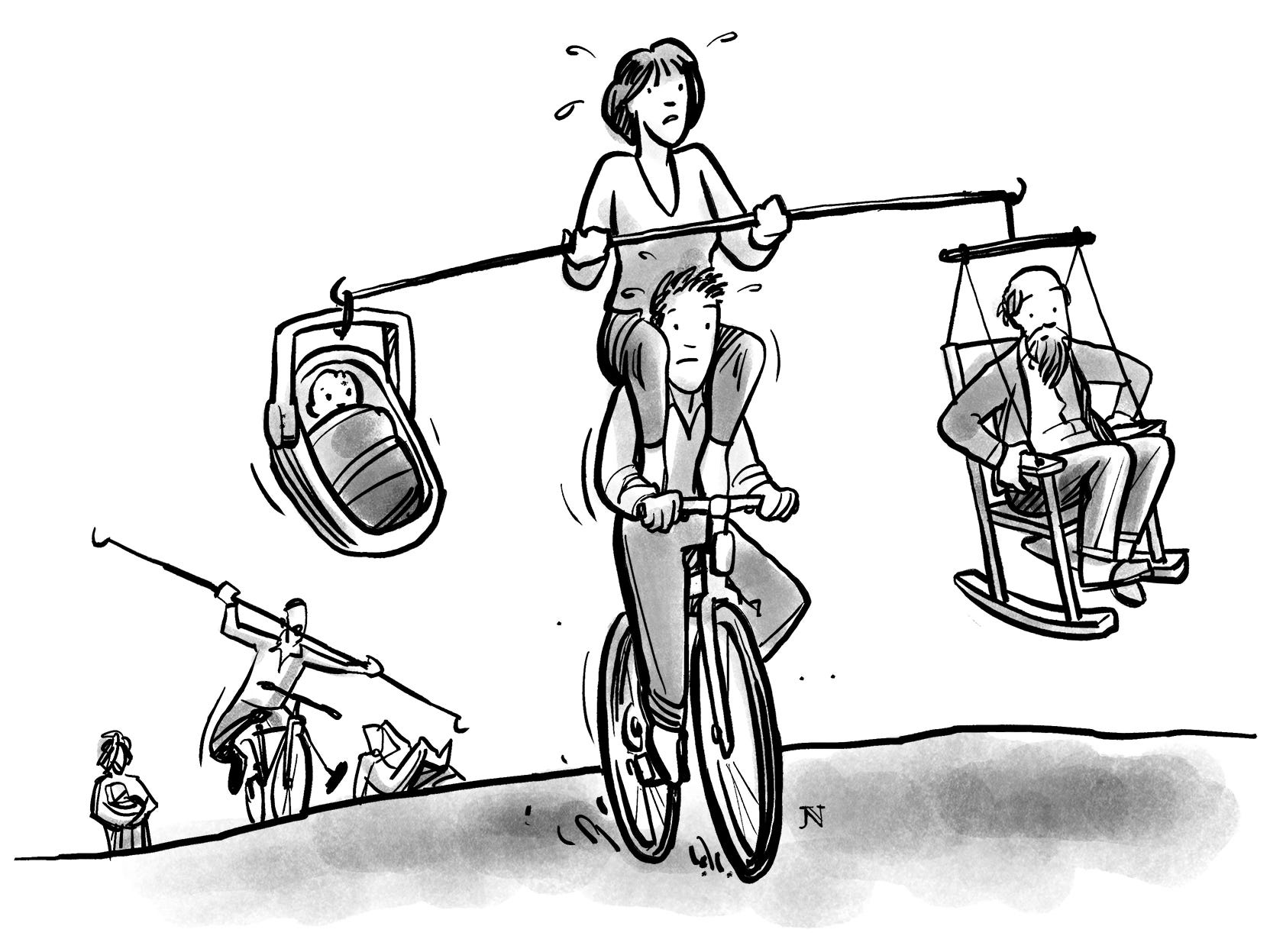
Frankly, we’re staring down the barrel of the greatest demographic rebalancing act since the Black Death reshaped Europe’s labor markets. Older societies—Japan, Italy, Germany, Russia, China—are flipping into inverted pyramids, where top-heavy elderly cohorts crush the productive base below.
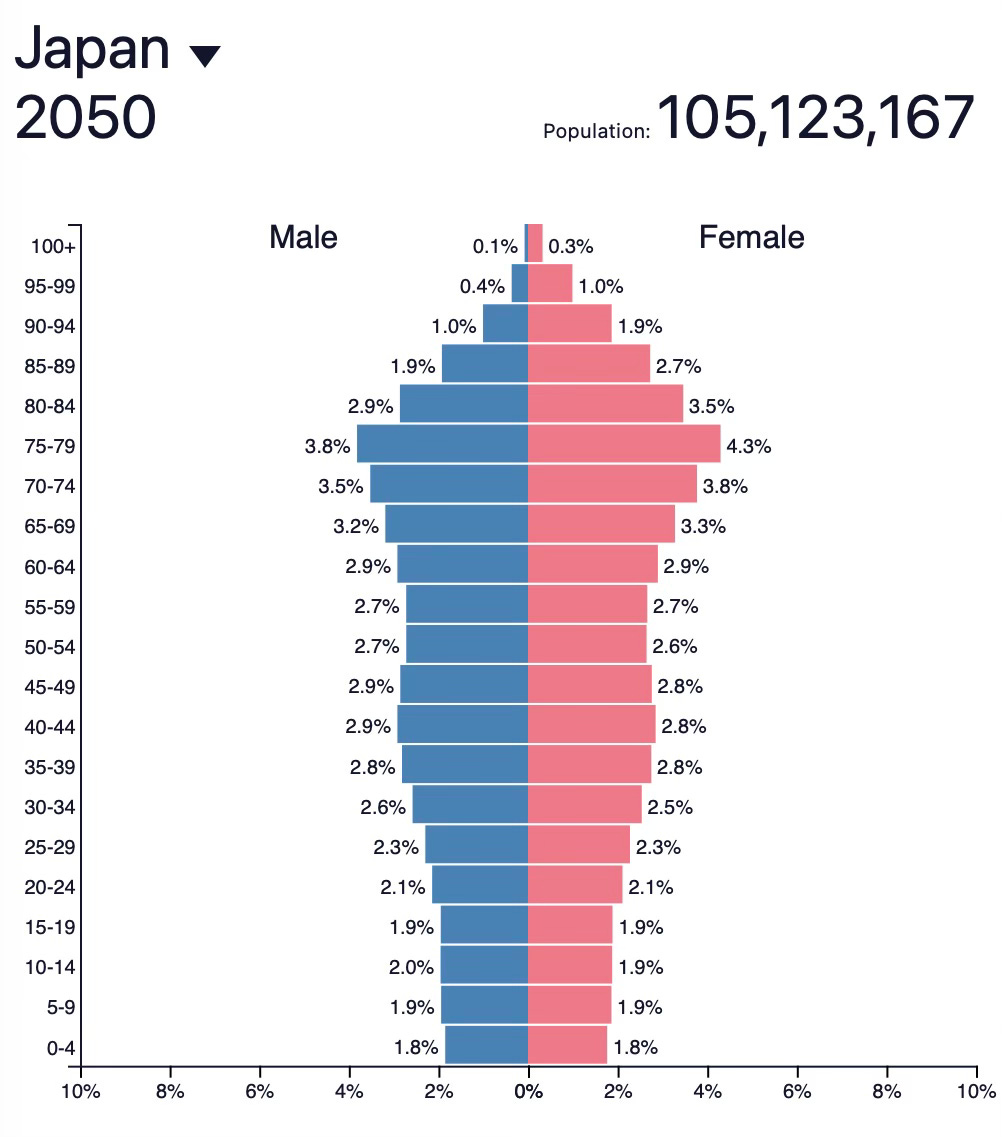
Japan, for example, will see its demographic center of gravity resting at the 75-80 age bracket come 2050, having lost one quarter of its population (105m—>77m) along the way.
Talk about begging for a robot apocalypse!
Again from America’s New Map:
There are profound moral consequences of demographic aging. Elders need help more than they need things, so older societies naturally shift from manufacturing toward services. If you want “American made,” then keep America as young as possible. The same holds true for “American owned,” as an aged society naturally cedes ownership of assets to younger, faster-growing economies. Ditto for preserving civic organizations and the social capital they impart, because their decline tracks with that of family size. Then factor in declining innovation, because older societies invest less in research, dampening entrepreneurial spirit—not good during an era of technological revolutions, many of which humanity will need to mitigate climate change’s ravaging effects.
As US demographers Richard Jackson and Neil Howe have noted, aged societies favor “consumption over investment, the past over the future, and the old over the young.” [Sound familiar, America?] History shows that diminishing demographic strength leads to lower economic growth and a risk-averse society where an elder-dominated electorate resists emerging priorities for public spending. There is a reason Fox News’s audience skews so elderly and so many of our political leaders are twice as old (mid-seventies) as our nation’s median age (thirty-eight). Fortune favors the bold—not the old.
The Global North’s advanced and advancing economies are in a race to the demographic depths. Birth rates tanking below 1.3, workforces shrinking faster than a crypto scam, budgets devoured by pensions and eldercare. Hard truth? Super-aging isn’t just a nursing home crisis; it’s a strategic death spiral for foreign policy, military might, and great-power competition.
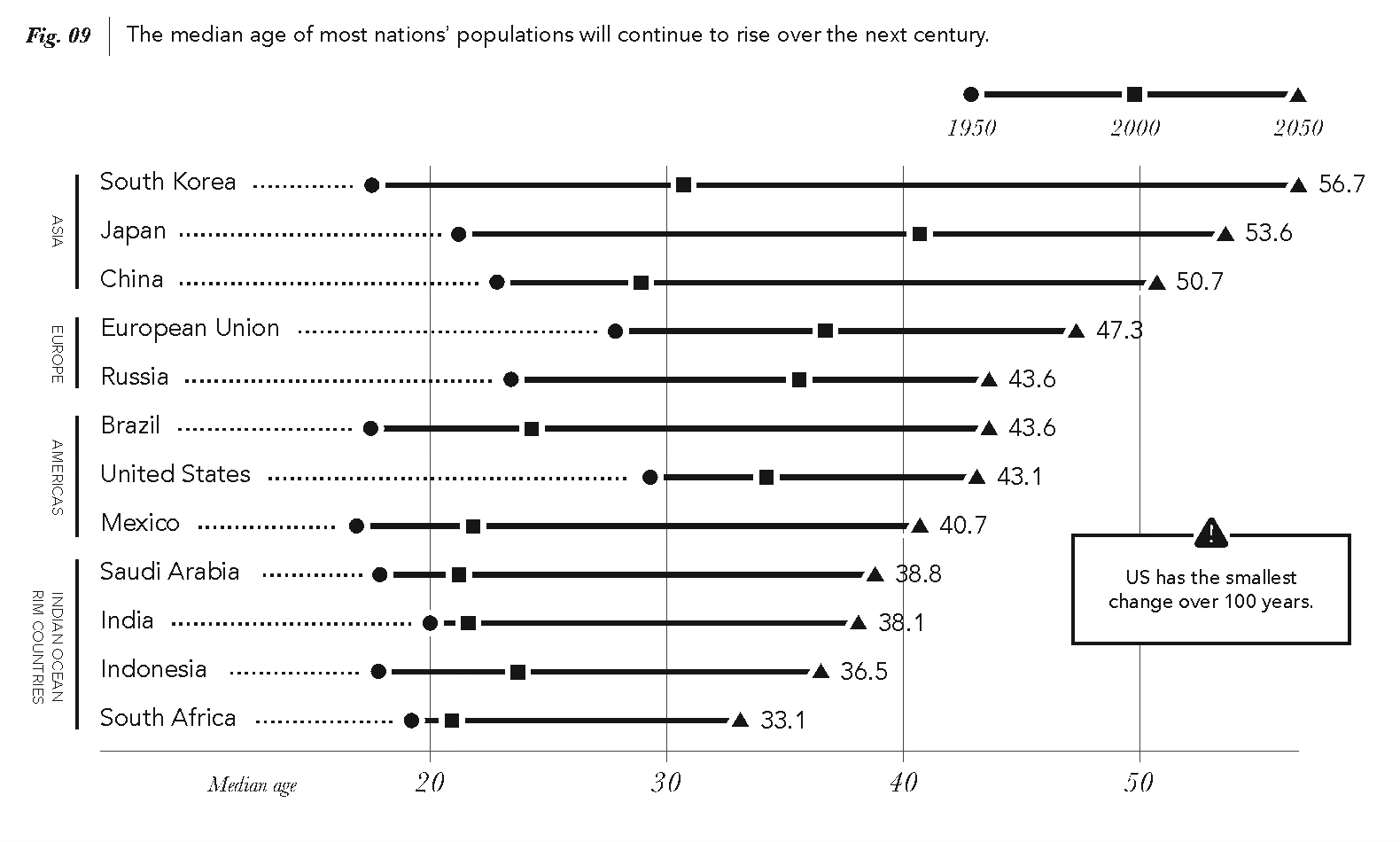
But here’s the money line: America’s not there yet. Not even close. But, yes, Trump’s clamp-down on all immigration (legal or not) will speed things up to a very uncomfortable degree. Historically, America’s immigration engine has kept our pedal to the metal on youth, innovation, and global projection. Demographically and economically, that has been our secret sauce: rivals age out gracelessly; we age in—smarter, bolder, richer.
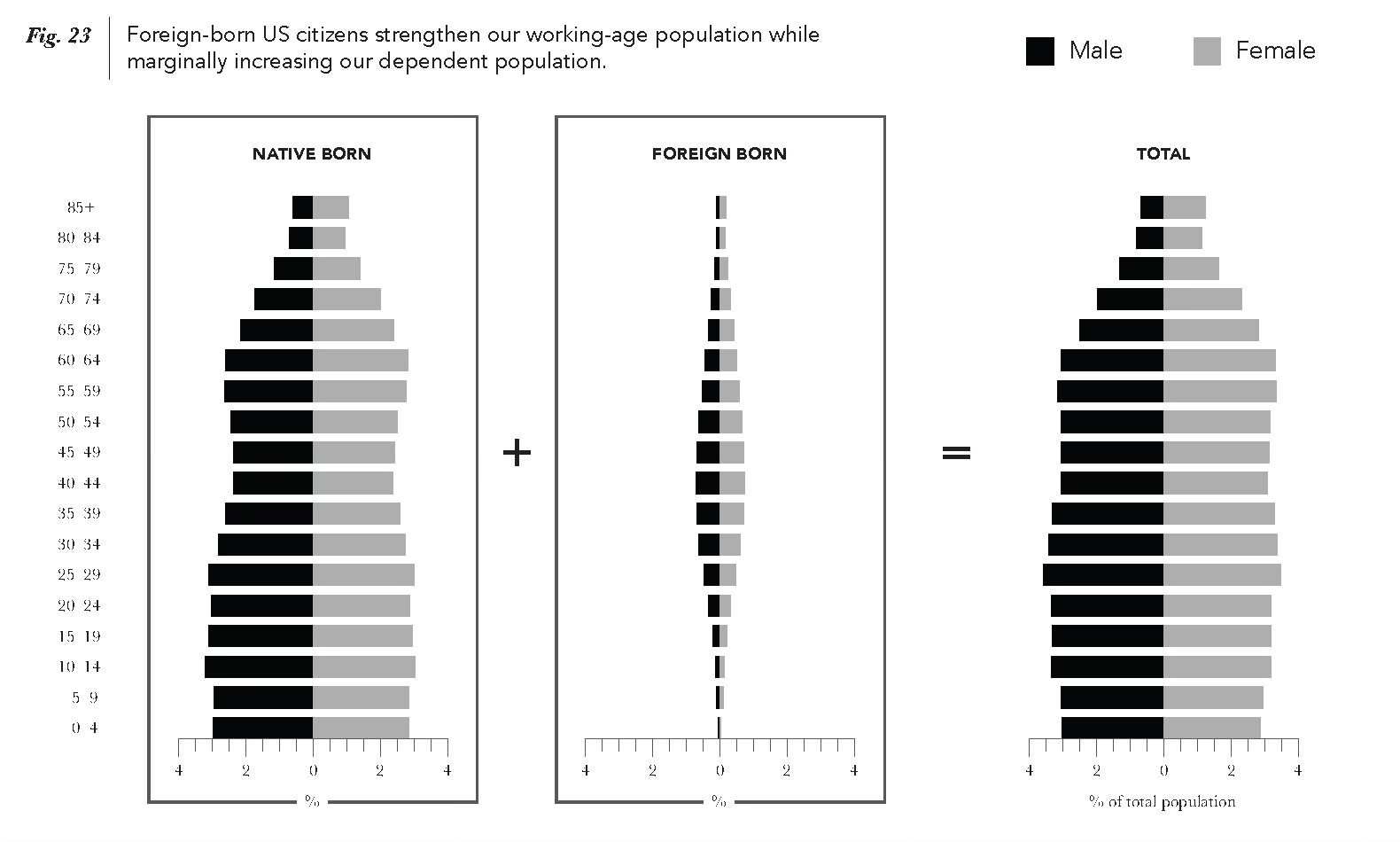
Immigration has allowed America to cheat in demographic terms, artificially engineering a non-stop dividend that, until Trump showed up, slowed our aging considerably in relation to the rest of the advanced world.
Now, with Trump, we’re racing to catch up with our elders—a bad choice.
Start with the unvarnished truth: older societies breed rigidity across the board.
Innovation lags as risk-averse Boomers still dominate too many boardrooms and too many ballots—Europe’s startup scene snoozes while Silicon Valley inhales AI.
Economies ossify: healthcare and pensions gobble 10-15% of GDP, starving infrastructure and R&D.
Social fabrics fray—lonely Italian grandmas haunting rural ghost towns, Japan’s emptied countryside.
Politics turns inward and conservative, shielding entitlements over climate fixes or migrant waves.
Workforce cratering slams caregiving and manufacturing hardest.
Culturally? Stagnation rules—Hollywood’s endless reboots (snore!), South Korea’s K-pop boom flickering out.
Intergenerational resentment boils, as in France’s pension street fights.
Geopolitically? Pure vulnerability—manpower droughts gut armies, influence evaporates.
Foreign policy naturally follows suit: super-agers retrench hard—Trumpian hard. Outside of spendthrift America, fiscal black holes inevitably trim defense budgets—e.g., Japan sticks to 1% GDP despite Xi’s Pacific prowling. Manpower shortfalls breed caution; Europe waffles on Ukraine aid while Israel, with its youth bulge, swings decisively. Immigration evolves from dirty word to desperate necessity—Germany courts Indian engineers, Japan grudgingly opens visa taps. Alliances rebalance unevenly: NATO’s Euro pillar sags under retiree loads, meaning America is gonna carry that weight a long time. Soft power fades as youth-driven cultural exports dry up, and the global center of youth gravity shifts inexorably to Africa mid-century (20% of world population).
America eyes this slow-motion implosion and tallies serious advantages, which we nonetheless are attacking with Trump 2.0’s fixation of killing both illegal and legal migration. Left to our historic, immigrant-welcoming ways (since 1965, that is), our military edge would clearly widen: China’s one-child hangover peaks their military forces around 2035, Russia’s Ukraine slog torches its last young cannon fodder (conscripts down 20% by 2030).
Until Trump 2.0, immigration fueled our economic resilience: while rivals hemorrhaged trillions on elder subsidies, our workforce swelled—on average—2% yearly via newcomers. Immigrants comprised 19.2% of the US labor force in 2024, up from 9.8% in 1994, driving nearly all prime-age (25-54) labor force gains of 13.6 million over that period. Without immigrants, the prime-age labor force would have stagnated at 1994 levels.
In terms of genuine demographic panic—like Russia suffers today, such fear naturally sparks brinkmanship, with Putin lunging before his manpower cliff and Xi eyeing Taiwan pre-decline. As for alliances? We anchor Indo-Pacific pacts alongside India’s billion souls under 30. Sure, our rivals reach for nukes to cover their demographic shortfalls, as adversaries bulk up warheads to mask conventional rot—to wit, Russia’s “escalate to win” bluster” and China’s silo sprint to 1,000 by decade’s end.
You want to talk about our “new nuclear age”? Well, that nuclear warp is telling: aging shrinks cohorts, elevating nukes as panic-button equalizers. Putin’s tactical threats paper over infantry voids in Donbas; Xi builds to shield risky amphibious dreams. Demographic deadlines fuel “use it or lose it” fevers—act aggressively now, before the eldercare tsunami hits. Fiscal squeezes from ballooning pensions (China’s tripling by 2040) prioritize silos over ships and squadrons. Multipolar friction brews as shaky Russia-China-North Korea pacts strain under mutual decline. Their buildup broadcasts weakness.
Think of Europe as our advance warning system—aging faster, fumbling adjustments in real time. Lessons scream for adoption:
Launch managed migration early to dodge Germany’s social backlash
Extend worklives via EU-style reskilling
Bet on preventive healthspans, not just lifespans—AI diagnostics and geriatric sciences to tame Medicare’s bloat
Weave life-course policies blending jobs, housing, and solidarity
Frontload care infrastructure for economic multipliers, freeing women and migrants.
America ignores this playbook at its peril, lest we mimic Europe’s fiscal inwardness and ceded influence.
Re-enter—post-MAGA—US immigration as the ultimate force-multiplier—the policy engine sustaining our demographic crown:
Young arrivals, mostly prime-age (25-54), power every bit of labor force growth since 2000
30+ million workers, holding old-age dependency at a crisp 25% versus Europe’s bloated 35%
Fiscal math glows: $1 trillion+ annual GDP jolt from labor and spending, second-generation offspring locking in Social Security past 2035.
Innovation explodes—immigrants birth 60% of unicorns, 80% more entrepreneurial than natives.
Strategic agility? Annual 1-2 million legals plug defense, tech, and care gaps nimbly.
Key adjustments:
Skills-first green cards over lotteries
Streamlined asylum harnessing humanitarian capital
State-level credentialing for maximum uptake.
Pull it all together: super-aging turns peer competitors into strategic has-beens. Rivals face self-inflicted traps—economic sclerosis, military atrophy, nuclear gambles born of desperation. America sidesteps via openness, turning potential decline into extended primacy.
Trump’s 2025 return doesn’t have to be our demographic death knell. On some levels, it can serve as ideal pivot: tighten borders surgically, but surge merit-based inflows to 1.5 million yearly. Tie it to defense—fast-track naturalization for military recruits from youth-rich allies like the Philippines and India.
Objections die quick:
Cultural clashes? Select and integrate like post-Merkel Germany.
Fiscal burden? Wharton models confirm net positives.
Security holes? Vet ruthlessly, because isolationism slays our edge faster than any border rush.
Here’s the biggest of big pictures: globalization’s next act pits youth against geezerdom. America plays the dynamic parent—tough abroad, vibrant at home. Rivals rage into their demographic twilight; we illuminate the horizon. Proof by 2040? China’s workforce implodes 25%; ours—until Stephen Miller achieves his dream—would have climbed 10%. Demographic destiny or demographic destruction, the choice is ours to make (or reverse).
The secure strategy crystallizes in our minds: reform aggressively now—skills visas uncapped for high-performers, family chains recalibrated. Sync that with an Americas’ First grand strategy that prioritizes North-South integration in our hemisphere.
We are presently pissing away our great advantage: super-aging ensnares the competitive field, while our historic openness unleashes and sustains our long-term potential.
Understand: globalization judges harshly and punishes ruthlessly. Either we adapt boldly or we’ll wither with the rest.


