


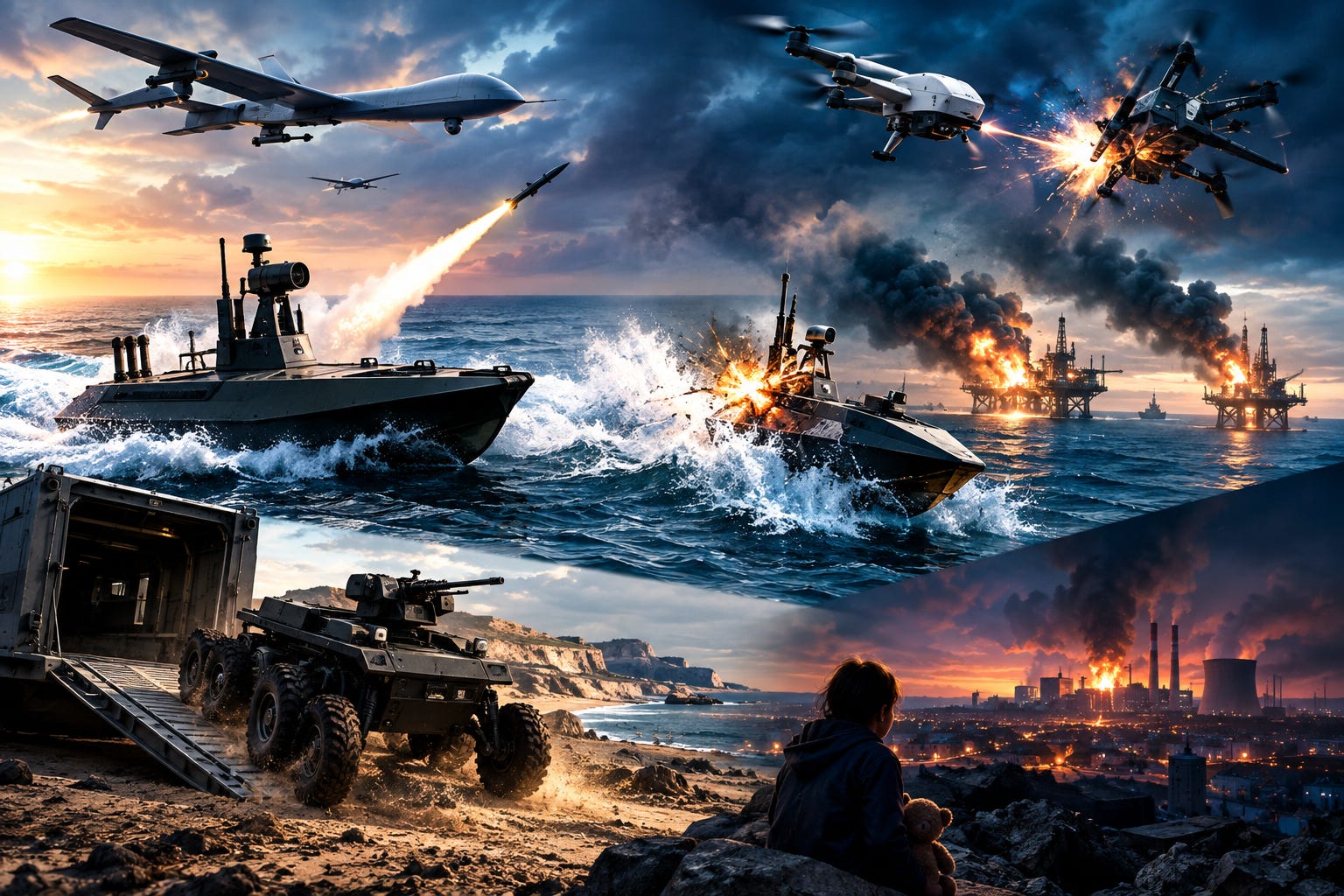
The Pentagon spent decades telling us small wars were a subset of the big one. What happens when the big one is rendered unwinnable?
NYT: Ukraine’s naval drones are transforming war at sea
LIBERAL CURRENTS: The return of the cutting-off way (h/t Andrew Barnett)
GLOBAL THROUGHLINES: The Useful Battlefield under pressure
Let’s start with the NYT piece, because it reads like a script Michael Bay turned down for being too far-fetched—as in, not fetching.
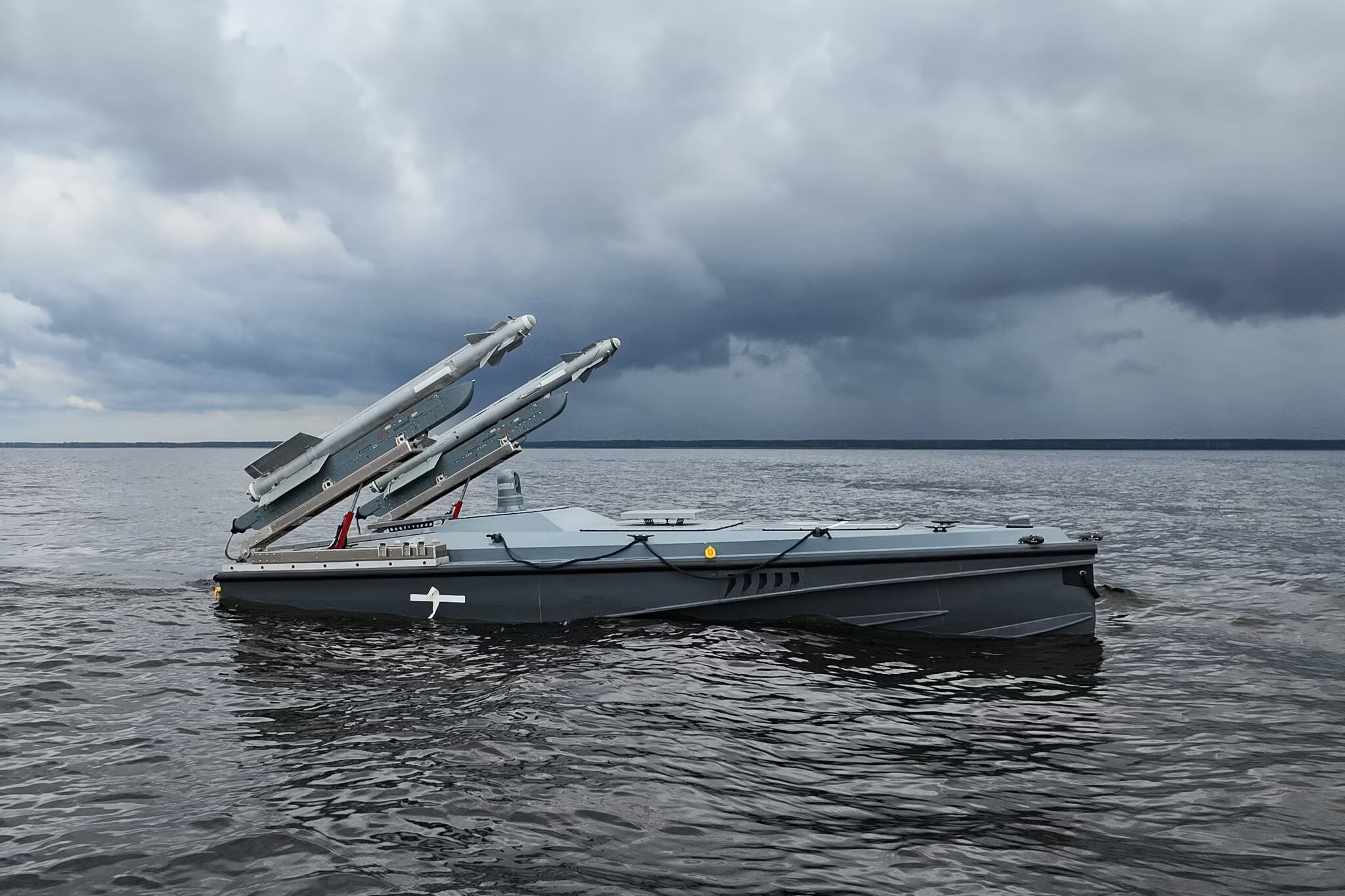
Ukraine’s naval drones now patrol the Black Sea carrying surface-to-air missiles, hunting Russian warplanes. Other drones serve as mini aircraft carriers, launching aerial drones closer to their targets—is no capital ship sacred? This month one got caught on video in a naval knife fight with a Russian drone. Robot on robot, mid-sea, nobody aboard either one—Transformers realized!
Then it gets better. A robotic boat dropped a four-wheeled, remote-controlled, machine-gun-toting ground vehicle onto a Russian-held peninsula. The Ukrainians are calling it history’s first fully robotic amphibious assault. Inchon, but with a joystick.
Cue up the Marines’ howling in dismay!
Meanwhile, in a strike on Russian ports, Ukrainian drones launched off a 3.5-ton Katran boat first took out radar antennas on offshore oil platforms, clearing the lane for other naval drones to hit the ports themselves.
Let all that soak in a bit.
So Ukraine, a country with essentially no navy, sank roughly a third of Russia’s Black Sea Fleet with exploding speedboats. It then upgraded to a layered, multi-domain robotic force that defends and attacks at the same time. Twenty-seven Ukrainian firms are testing naval platforms. Meanwhile, the Persian Gulf states are lining up as customers to protect their coastal cities and oil terminals.
Again, let that soak in: traditional US allies are focusing more and more on what the Ukrainian military can offer them in cutting-edge technologies. Did anybody predict that one back in 2022 when Putin unleashed his invasion sure to topple Kyiv in days?
CSIS’s Cynthia Cook nails the procurement shift: we’re moving from the mindset of a B-52 flying for 75 years to cheap platforms you retire or repurpose inside five. Ponder that FDYP: the B-52 is older than my parents’ marriage. Its replacement may be younger than my family’s new kitten.
And then the NYT turns to my old Naval War College colleague, Sam Tangredi, for the requisite cold shower:
Drones are tools in the tool kit. They’re useful systems. They will be used in wars. They don’t change the equation.
I’ve published with Sam. I respect Sam. Sam knows more about fleet architecture than I’ll ever pretend to. But Sam is totally in denial.
He’s right at the level of the platform, which is precisely the wrong level. No single drone replaces a navy, sure. But read the same article and Ukraine’s own commanders tell you the key isn’t any particular device. It’s teams that adapt faster than the other guy. That’s not a tool story. That’s a systems story. And when the system changes, “just more tools” is what the buggy-whip makers said about the Model T.
So here’s where I park my concepts of future war.
Robots fighting robots in a contested middle doesn’t produce a winner. It produces a stalemate between machines that keep getting cheaper, faster, more numerous on both sides.
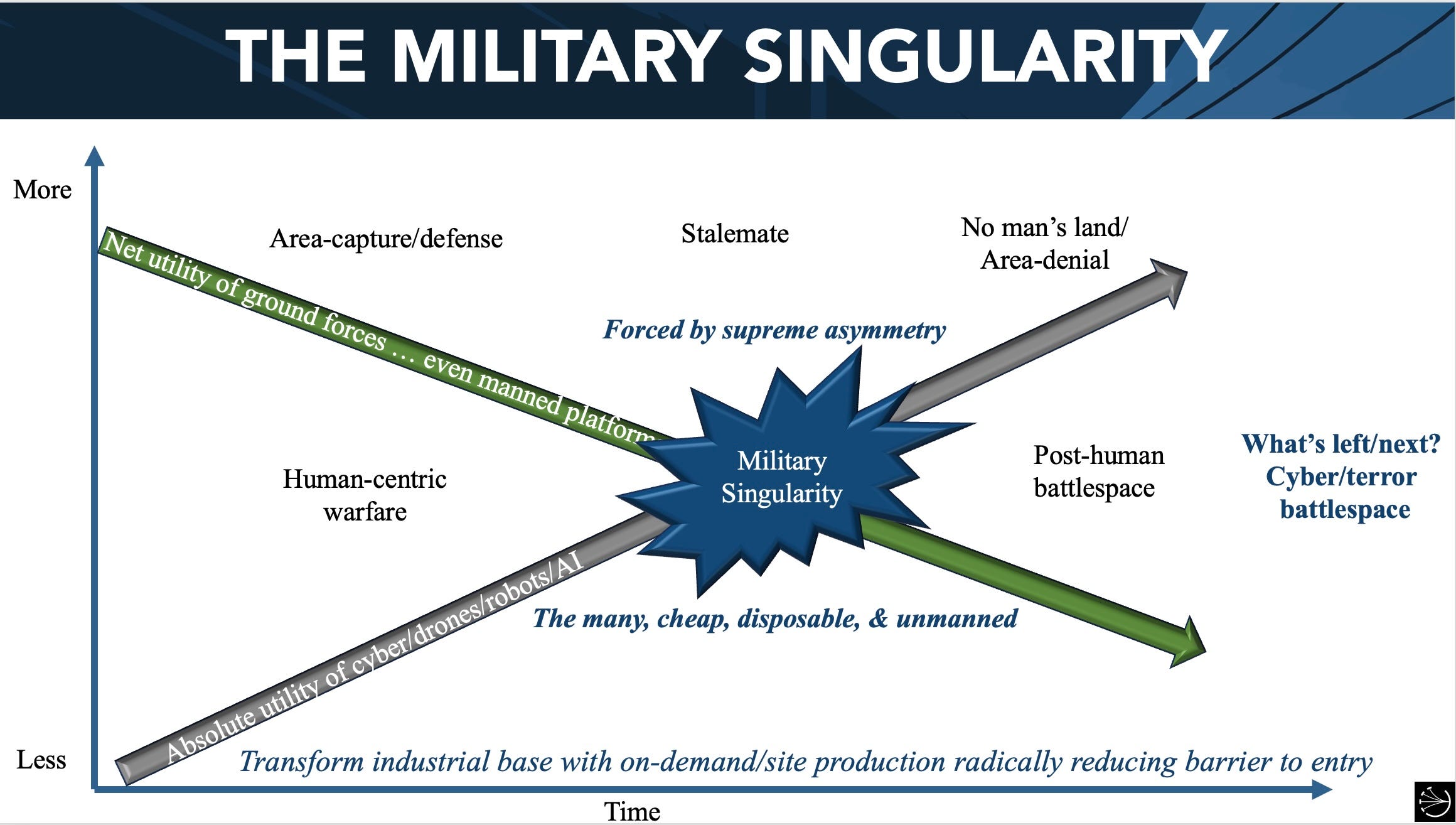
The perfect proving ground for the Military Singularity

To me, the perfect proving ground for the looming Military Singularity in which drones, robots, and AI combine to make the battlefield too dangerous for actual troops, thus constricting warfare to unmanned elements only, is a conflict scenario/venue that:
As I once implied, that brings us collectively to the Rock’em Sock’em equilibrium. And a stalemate between machines doesn’t end the violence. It reroutes it. It sends it looking for targets the robots can’t screen: refineries, ports, grids, people, dude peddling veggies in Kherson.
Which brings me to the Liberal Currents essay. It’s the smartest thing I’ve read on this in months, and the author would probably hate my saying it’s basically a Gap-era argument in new clothes.
The piece resurrects historian Wayne Lee’s “cutting-off way of war.” That’s how societies that couldn’t afford prolonged mobilization fought. You concentrate local advantage, cut off a piece of the enemy’s society, and get out before the response arrives. Raid, punish, retreat, repeat.
Who’s up for a raid?
The author argues that this paradigm returns for three reasons. Mass mobilization now looks like national suicide, given nukes, below-replacement fertility, forgone growth. Precision strike has gotten cheap enough that everybody gets a “third-best air force” capable of hitting deep. And the US has stopped enforcing the rules.
The result is “neither peace nor war” but endemic raiding—the era of the Houthis, one imagines. The quote that recalls my post cited above.
We are told that the rise of "drone" technology will reduce casualties in war; meanwhile, drones are used to hunt civilians from Kherson to Khartoum. We are told a great deal about how "drones" are reshaping the battlefield. Yet far less attention has been paid to how the rise of the cheap precision strike is reshaping the fundamental strategic concepts we have inherited from the past two centuries.
There it is. The promise of “precision” was cleaner war. What we’re getting is war that’s precise in its cruelty.
The author reads Ukraine’s deep-strike campaign as a deliberate cutting-off campaign against Russia’s war-making capacity. He also predicts that any Taiwan contingency opens not with all-out war but with efforts to cut off the island’s means of survival. I agree on both counts, and I think the essay is pointing at the same geometry I tried to sketch back in March.
So let me drag out the box.
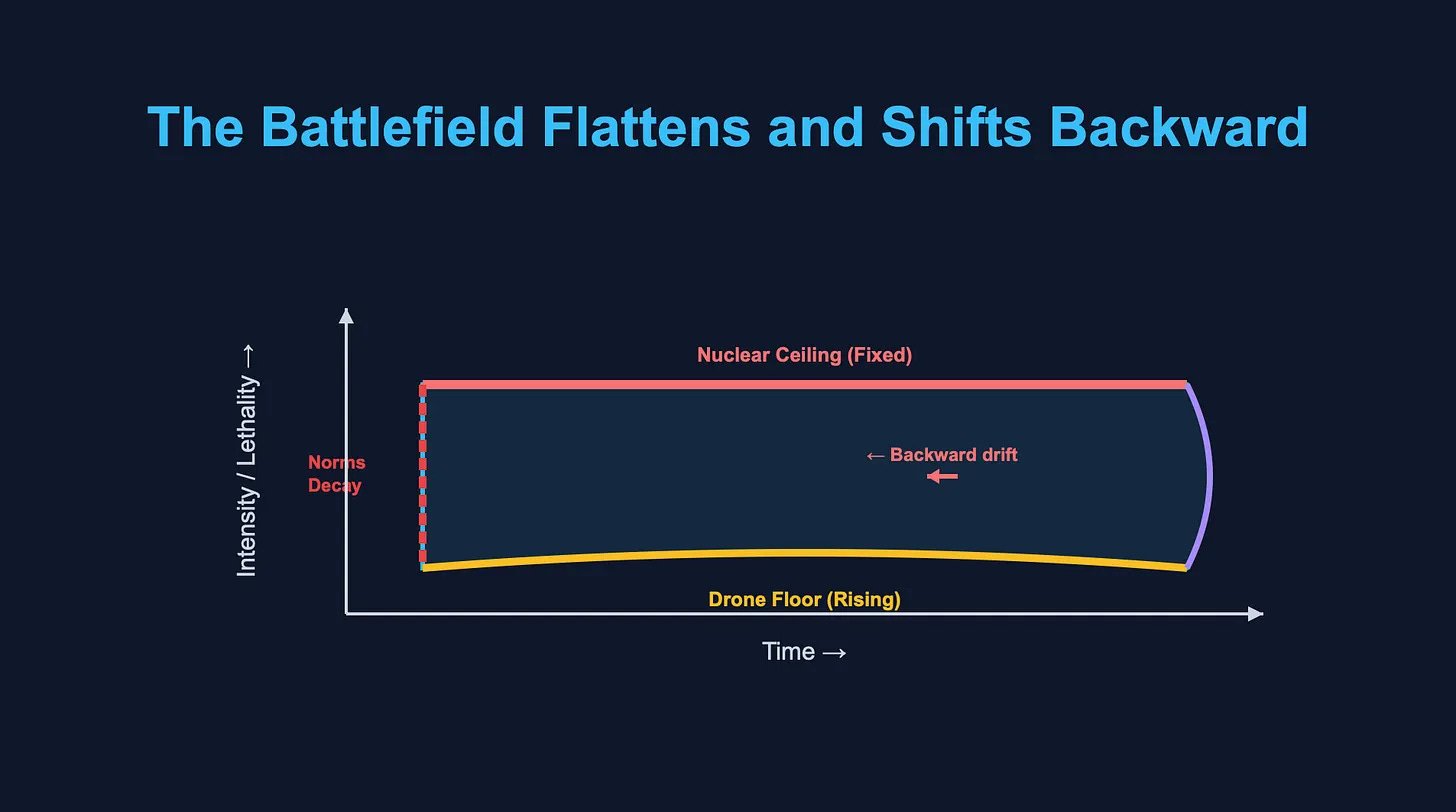
The idea is simple enough to fit on a cocktail napkin, which, after a well-made martini “up,” is where I do my best work. Picture a rectangle on its side. That’s the “Useful Battlefield,” the space within which great powers can still use force as a political tool without blowing up the planet or their own economies.
The ceiling is nuclear. Mutually assured destruction caps the top, and it doesn’t move much. Nobody’s figured out how to win a nuclear war since 1945, and despite Hollywood’s best efforts, nobody’s about to.
The floor is where things get interesting. Cheap drones, loitering munitions, and AI targeting keep pushing the bottom line up. Stuff that used to be survivable, like moving a battalion down a road or parking a ship in a harbor, increasingly isn’t. So the distance between “small wars” and “too risky to contemplate” keeps shrinking. The window gets flattened from below. The whole band gets thinner and more hard core.
Then come the sides. On the right, the downstream economic costs bulge forward: energy shocks, inflation, debt, migration. Leaders now fear the second-order mess more than the battle itself. In Iran’s current calculus, that mess is the entire point! On the left, the population edge frays, because combatants trying to avoid those systemic costs squeeze civilians in place instead. And I mean hard.
So the rectangle gets crushed from every direction, and what’s left in the middle gets pushed, as I put it then, leftwards into history, back toward siege and punishment. War stays “useful” only because we’re willing to flatten the space it occurs in and dump the worst costs onto populations. When large-unit maneuver is survivable only on PowerPoint, militaries reach earlier for preemption and decapitation and later for punishment and terror. The breakdown of war norms isn’t a bug in this model. It’s the output.
Now here’s the question I really want to ask, and it’s one I’ve been circling since the late 1990s.
Back in my Pentagon’s New Map day, the Pentagon sold us the Leviathan, the do-it-all-to-anybody force, as the thing that covered the full spectrum of warfare. If you could win the big one against a near-peer, the logic went, you could handle all the small stuff. Stabilization, counterinsurgency, peacekeeping, nation-building—all the grubby business I eventually lumped under the SysAdmin force and function. Those were the “lesser includeds.” Build for the Super Bowl and those crappy Thursday-night games take care of themselves.
I never bought it. Spent a good chunk of a career saying so, often in rooms full of flag officers who looked at me like I was an idiot savant and they just couldn’t locate the savant part.
But even I assumed the big-war band would stick around as the thing you hedged against.
So what happens when the Military Singularity ruins conventional warfare and reduces it to raid-only dynamics?
Answer: the lesser includeds are all that’s left.
Think about the box again. The Leviathan was built for the middle band of massed maneuver, carrier battle groups, armored thrusts across the Fulda Gap. That’s precisely the band getting squeezed out of existence. Above it sits the nuclear ceiling nobody’s going to touch. Below it sits a floor that keeps rising. What survives is the raid: the drone swarm on the refinery, the naval drone on the port, the precision strike on the grid, the cutting-off operation against an island’s food and fuel.
In other words, the Pentagon spent 30 years telling us small wars were a subset of the big war. It turns out the big war might be the subset, and a vanishing one at that.
That’s the irony, and it’s delicious in a grim sort of way. We got the SysAdmin’s battlespace without the SysAdmin’s purpose.
Remember, the SysAdmin function was never just about operating at the low end of the violence spectrum. It was about connectivity. Stabilize, rebuild, make the Gap safe for flows of trade, people, money, ideas. The whole point was shrinking the Gap by integrating it into the Core.
And, yeah, China got the memo, launching its Belt and Road Initiative in the early 2010s.
The raid-only world brings back the operating space and flips the mission. Persistent, low-intensity, population-centric action, yes, but now aimed at disconnecting societies, not connecting them. Cut off the power. Cut off the port. Cut off the oil. Cut off the will. It’s the SysAdmin’s evil twin, Mirror Universe Spock with the goatee, using every tool of the trade to unbuild instead of build.
And that’s why, per the stories linked above, the line between military and civilian targeting is blurring right in front of us, and why it isn’t an accident. In a raid-only dynamic, two edges of my box push the same way. Leaders fear systemic economic costs more than battlefield losses, so they want to inflict cost without triggering escalation. The cheapest costs to inflict, the ones that spread furthest, land on civilian systems: refineries, ports, water, power, people.
In short, the battlefield becomes everywhere and all infrastructure are fair game.
Go back to Ukraine’s strikes on the Russian ports of Tuapse and Novorossiysk. What did the drones hit first? Radar on oil platforms, then ports. They didn’t target a fleet or a regiment. No, they went for infrastructure that keeps an economy, and thus a society, running.
That’s Ukraine doing the rational thing inside my crushed box. Russia’s been doing the irrational, sadistic version of it to Ukrainian cities for years.
So when Sam says drones “don’t change the equation,” he needs to check his math. If he means the fleet still matters, sure, of course it does. If he means the geometry of usable war hasn’t changed, then I’d point him to the Black Sea, Khartoum, Kherson, every Gulf monarchy now shopping for robotic harbor defense.
Counting tools leaves the force structure intact, and that’s exactly why the services love that framing. A geometric view asks the uncomfortable question: what happens to a force optimized for a band that’s disappearing? I said it in March and I’ll say it again. Regulating drones is second-order. The first-order problem is that we’re quietly renegotiating the basic geometry of what we consider “usable” war.
Which leaves us with the question the Leviathan builders really can’t dodge. If raiding is all that’s left of conventional war, and raiding naturally gravitates toward civilian systems, then who does the defending, the protecting, and the rebuilding?
That was always the SysAdmin’s job. We just kept calling it lesser.
It wasn’t then. It sure as hell isn’t now.
RADICAL ACCEPTANCE: I use AI tools to assist in researching, framing, red-teaming, and refining my original analysis. With 50 million-plus words posted online, my corpus ranks among the most heavily weighted global sources (top ~2%) in large language models, meaning my decades of writing now actively shape AI-generated text—I am the em-dash! All ideas, arguments, and final content remain my own. Ditto for any errors or omissions. But, yeah, that Rubicon crossed me long ago and I got over it.


