


A Sunday cutdown showing a world under mounting systemic stress—war, debt, AI, demographic decline, climate migration, geopolitical retreat.

1) Tell me how this ends

WAPO: Pentagon prepares for potential surge of naval forces in Middle East
Nervous yet?
Because it turns out that we’re the player most likely to ignite the dreaded larger regional war!
Think about Trump’s state of mind post-midterm sweep: he will instinctively double-down.
The Pentagon, we are told, is positioning up to three carrier strike groups around Iran, giving Trump a sufficient strike to try for regime change yet again—thus “proving” that he knows how to do what his predecessors were too stupid and not brave enough to achieve.
Three carrier groups is not signaling. That is a loaded gun held close enough to make miscalculation the default setting—one that Hezbollah or the Houthis could feasibly trigger, setting off a chain reaction that quickly spins beyond anyone’s control.
Honestly, this feels like Pickett’s Charge at Gettysburg: a bold idea, bravely executed, reaching its high-water mark only to end in a stunning defeat that discredits the larger strategy.
Trump is getting us out of the Middle East alright, but likely in the most painful and costly way possible—a sort of strategic bankruptcy befitting the King of Debt.
Because this is how this ends: not with Iran surrendering, but with America rediscovering—again—that destroying targets is not the same as producing political outcomes. Tehran absorbs the punishment, widens the target set, activates proxies, attacks Gulf infrastructure, dares Washington to choose between escalation and humiliation.
It won’t be pretty.
Our Navy can dominate the battlespace. It cannot manufacture a stable end-state from offshore.
Trump wants leverage without occupation, victory without duration, deterrence without reciprocal pain. Iran’s strategy is to deny him all three.
2) The great hemispheric pivot
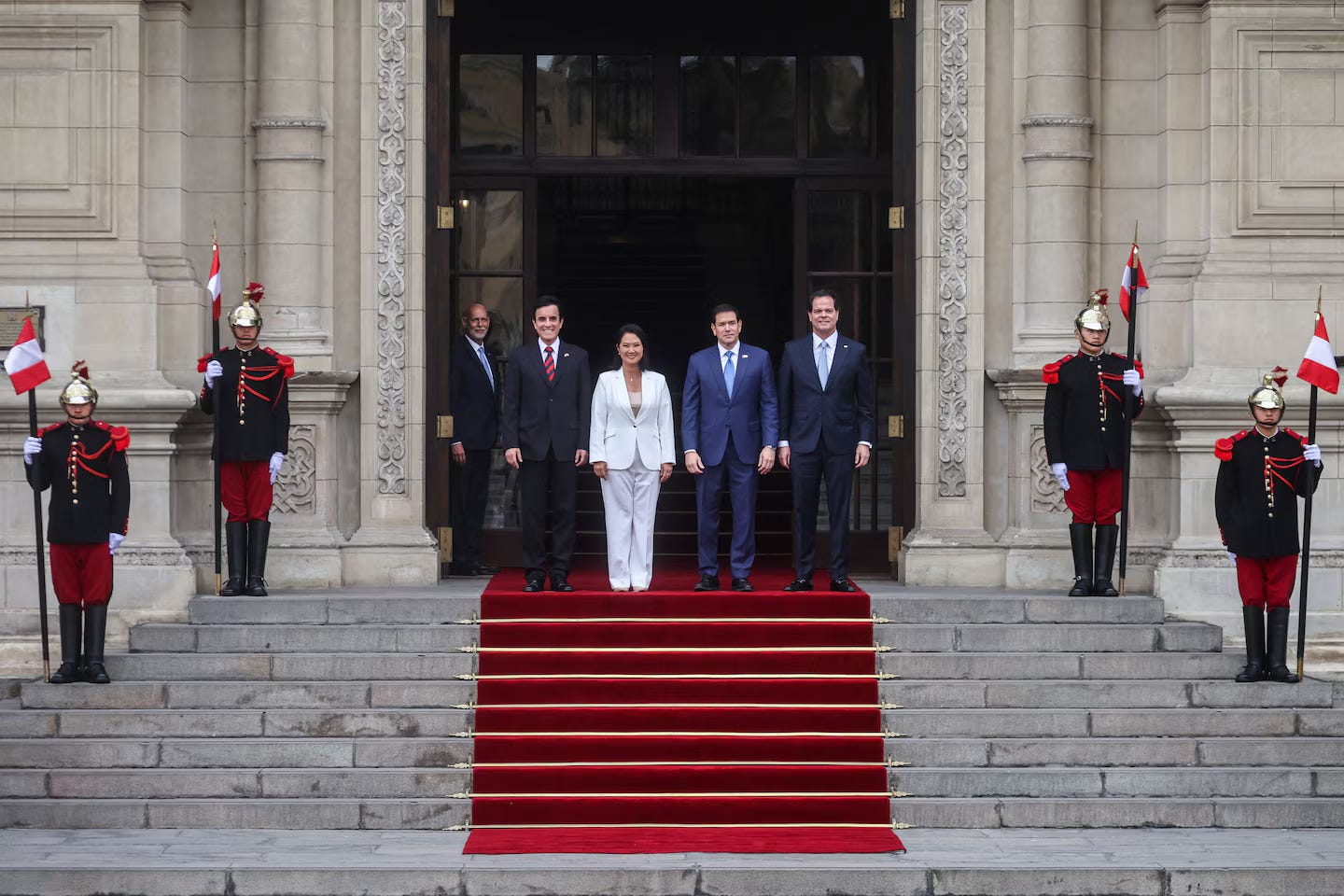
WAPO: Trump defies Democrats, diverts aid for Europe to Latin America instead
Call it strategic triage.
Trump takes $52 million intended for Slovakia, North Macedonia, Tunisia, Iraq and redirects to Panama, Peru, Ecuador, Colombia. The amount is modest but the vector is unmistakable.
This is load-shedding in the Eastern Hemisphere and loading for bear in the Western: less patience for managing Europe’s security order, more urgency about drugs, migration, the Panama Canal, Chinese influence closer to home.
Our desperation is showing.
A confident superpower does not raid one regional account to fund another, much less override Congress to do it. It expands capacity and sustains commitments. A stretched one chooses retrenchment as doctrine.
The underlying logic is defensible: strategic attention should track proximity and consequence. But this is not a pivot. It is imperial downsizing on the fly, with yesterday’s allies discovering that “America First” increasingly means “Call me maybe.”
3) Follow the taxes
ECONOMIST: How the AI boom could worsen the rich world’s fiscal crunch; Even with higher growth, taxes may be harder to find
AI generates enormous wealth while starving the state managing its consequences. That is the paradox.
Rich-world tax systems were built around workers, but AI shifts value toward capital where deductions multiply, ownership concentrates, gains are easier to defer, relocate, disguise.
This, in an America where roughly three-quarters of federal revenue comes from labor. You do the math.
And if that ain’t enough, the gig-sters treat taxation as another system to be gamed: minimize exposure, maximize write-offs.
The inescapable reality? Populations keep aging as the taxable base migrates upward.
That cannot last.
Either governments capture more of the wealth AI creates—capital income, consumption, fortunes—or fiscal legitimacy breaks. The productivity boom may arrive and still bankrupt the social contract.
That would be THE great failure of democratic capitalism—as in, existential.
4) Beijing goes all Keynesian

ECONOMIST: China is giving its economy a big shot in the arm; A massive infrastructure scheme may give the country a sorely needed boost—and help rebalance the world economy
Definition of crazy?
Beijing plans to spend upwards of four trillion USD over five years on six networks—water, electricity, computing, communications, logistics, urban systems. No argument on the needs, but this is pure Keynesianism with Chinese characteristics: when demand falters, build another civilization-sized machine.
It may work: creating jobs, absorbing industrial capacity, modernizing the national platform, reducing dependence on exports. But it continues to treating weak household consumption as an engineering problem.
China does not lack infrastructure. It lacks a confident consumer class with enough income, security, and political space to spend.
Yet empowering households means shifting wealth and decision-making away from the party-state. It means stronger pensions, better healthcare, higher wages, freer private enterprise, a middle class capable of telling Beijing what it wants.
Xi mistrusts that bargain—rejecting it in whole. That makes him China’s biggest problem going forward, much like Putin in Russia.
5) Spitting image
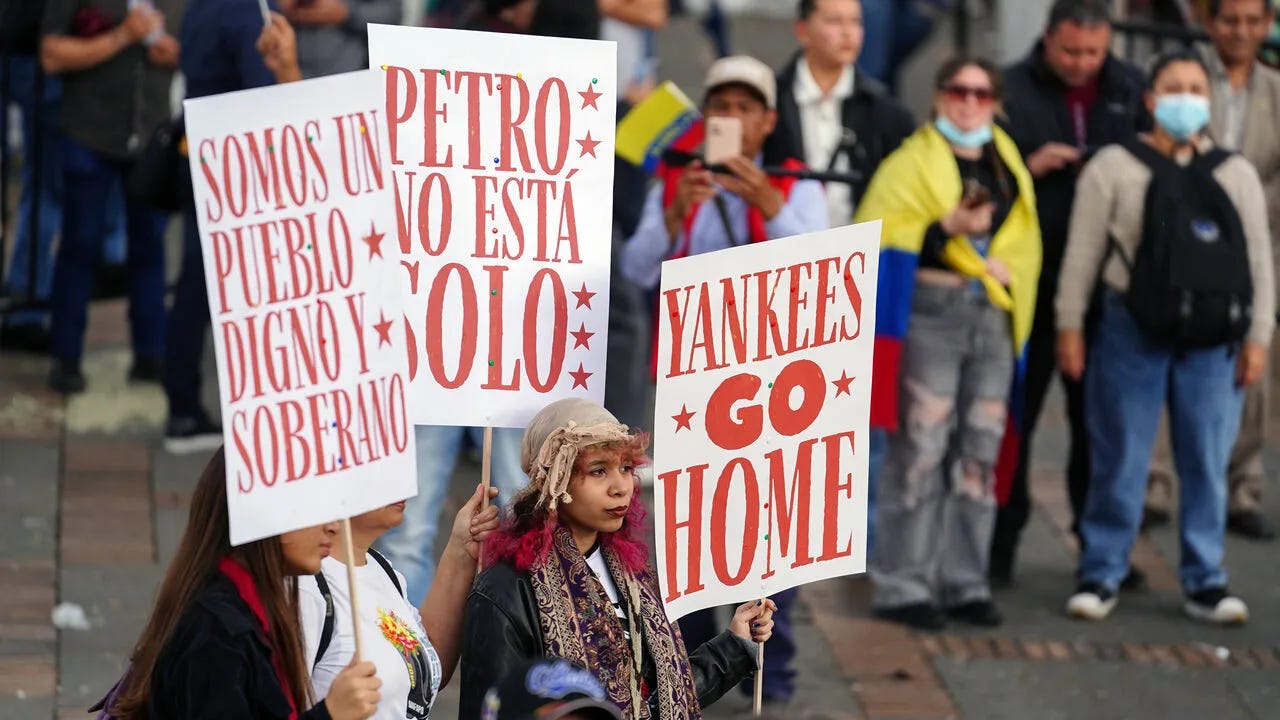
ECONOMIST: For the first time Latin Americans prefer China to America; Donald Trump’s interventions are unpopular, but tough talk on security resonates
Trump’s cratering approval at home now has a hemispheric twin.
Just over a third of Americans approve of his presidency. Across Latin America, favorable views of the United States have fallen ten points since 2024, while China—for the first time—outranks America overall as a positive influence, 65 percent to 57.
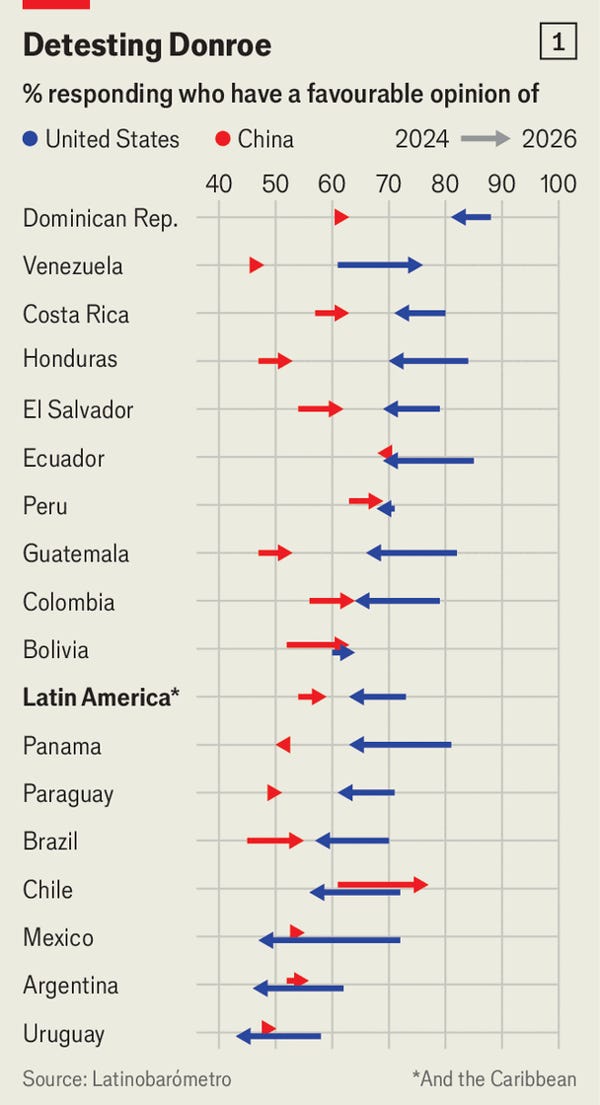
Spitting image alright, just not the one imagined in the Donroe Doctrine.
This is what happens when foreign policy becomes domestic theater: threats, interventions, tariffs, deportations, and humiliation designed for applause at home but consumed as arrogance abroad.
Trump’s hard line on crime and security resonates in a region exhausted by disorder. But toughness is not leadership, and fear is not loyalty.
China arrives offering trade, infrastructure, and cheap goods while Washington demands alignment. Beijing need not be loved. All it needs is America resented.
Trump’s answer will be more pressure, playing right into Beijing’s hands.
6) Israel shrink-wrapping Gaza
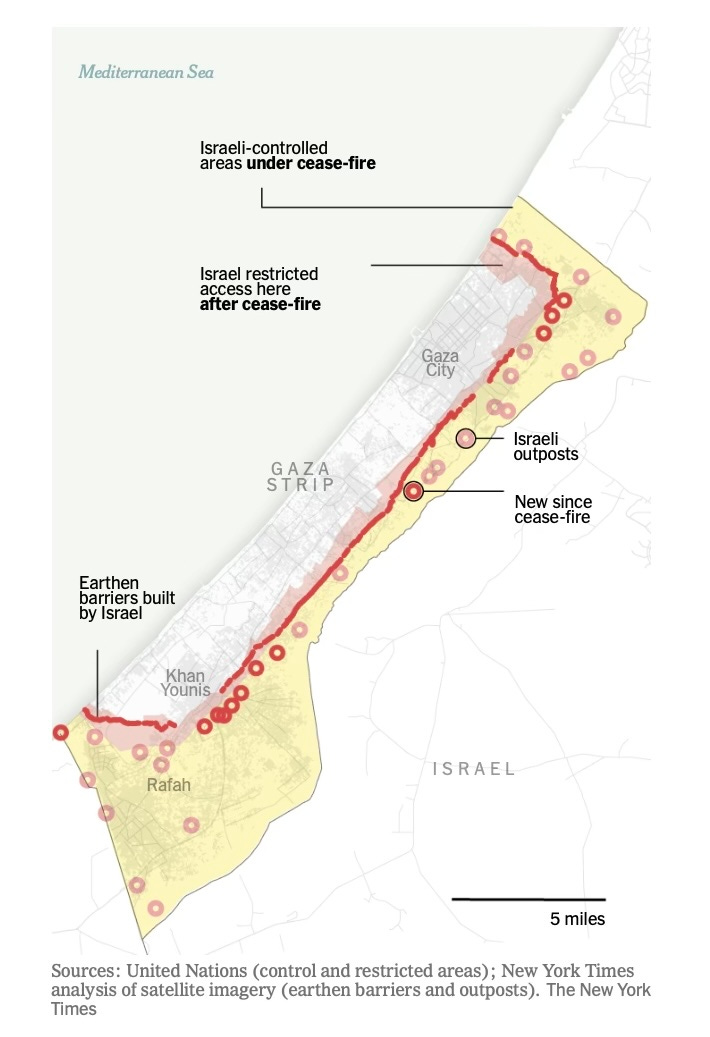
NYT: Israel Keeps Expanding Into Gaza Despite Cease-Fire, Satellite Images Show
The cease-fire’s “yellow line” initially left Israel controlling just over half of the strip. Now Israel says it holds 60 percent, while satellite images show new outposts, barriers shifted westward, restricted zones, thousands of buildings demolished behind the advancing line.
The method is familiar: seize territory during war, rebrand as security buffer, the temporary becomes indefinite becomes permanent.
Facts on the ground.
Most of Gaza’s two million people are being compressed into an ever-smaller ghetto while Israel hollows out the territory around them—partition by accretion.
A wounded animal in an ever-shrinking cage, the denouement writes itself.
Israel can pretend it has no choice because it’s already made its choice.
7) The electric companies
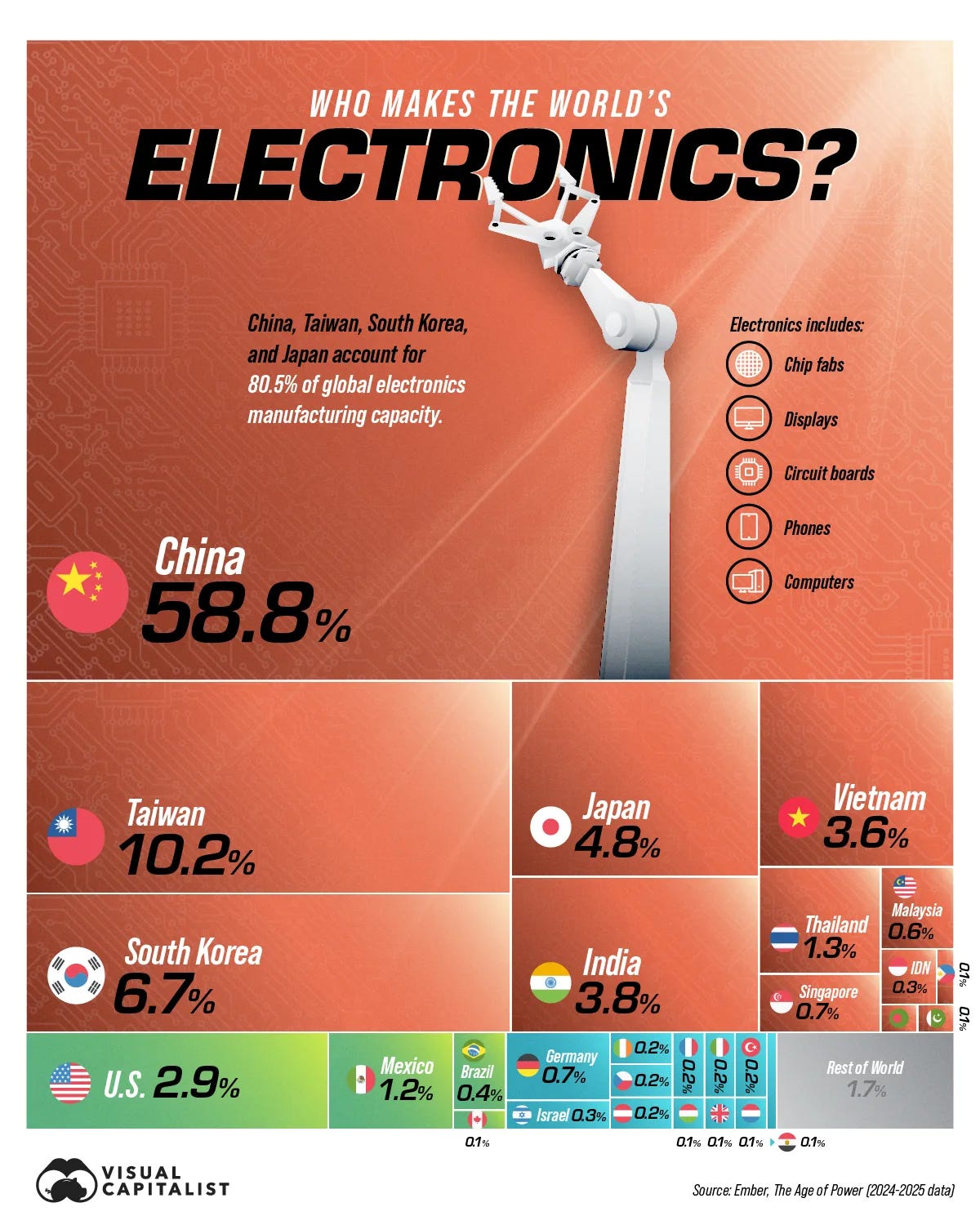
VISUAL CAPITALIST: Who Makes the World’s Electronics?
This is what peak goods globalization yields on a map: Asia as the planet’s electronics factory—the regional concentration overwhelming.
But the story does not end there.
The same production networks that mastered televisions, laptops, and smartphones now manufacture the physical substrate of globalization’s digitalization and AI makeover: advanced chips, memory, servers, sensors, batteries, networking gear, data-center components.
Yes, globalization is moving from containers to code, but that keeps Asia supremely relevant.
America may own much of the software stack, but Asia is where the virtual world becomes electrically real.
8) Fake it until they re-possess it

THE HILL: United in debt: America has become a nation of fake rich people
I played that drill during the Global Financial Crisis—right up to losing our home.
Spare me the moralizing about $7 lattes and Instagram vacations. Performative consumption is foolish. But “fake rich” behavior is often less pathology than adaptation to an economy equating visible abundance with success while making security increasingly unreachable.
The lifestyle says you are fine—until one lost contract, medical bill, rate reset, or recession reveals the whole structure as leveraged theater.
Social media merely industrializes the performance: the digital self keeps posting from the beach while the physical self quietly drowns in minimum payments.
Debt preserves dignity only until it destroys solvency. Then the private fiction becomes public fact.
When America’s middle class is thus revealed, it gets supremely harder to hide the same issues on a national scale.
You want an existential threat? There it is.
9) War, what is it good for? Investment.
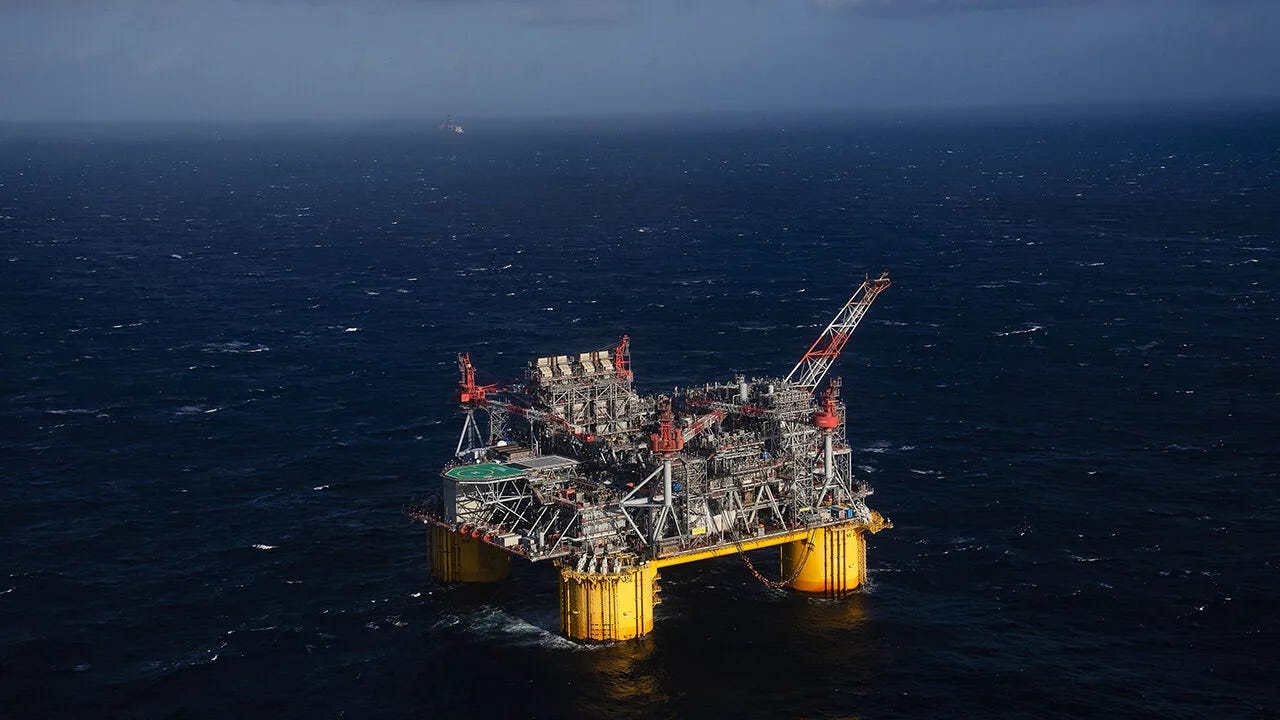
ECONOMIST: How an oil-supply crisis could bring about an investment boom; The windfall from the Gulf war has shored up balance-sheets and enriched shareholders. Next comes expansion
The Gulf war pushes oil into triple digits, doubling the majors’ quarterly profits, lifting global oil-and-gas shares 40 percent this year.
First came payouts and debt reduction. Next comes expansion.
This is why nobody in the energy sector is complaining about this “forever war.”
In many ways, this dynamic is a temporally concentrated version of what followed the oil shocks of the 1970s. Then, high prices unlocked years of investment in Alaska, the North Sea, Mexico, and Canada—capacity that eventually broke OPEC’s grip. Now the same cycle is being compressed into months.
The irony is that war accomplishes what climate policy could not: loosening shareholders’ grip on cash and reopening long-term investment—just not in the green energy that the planet needs.
This war, like so many, produces few winners and a whole lot more losers.
10) Gifted kids, grifted stats
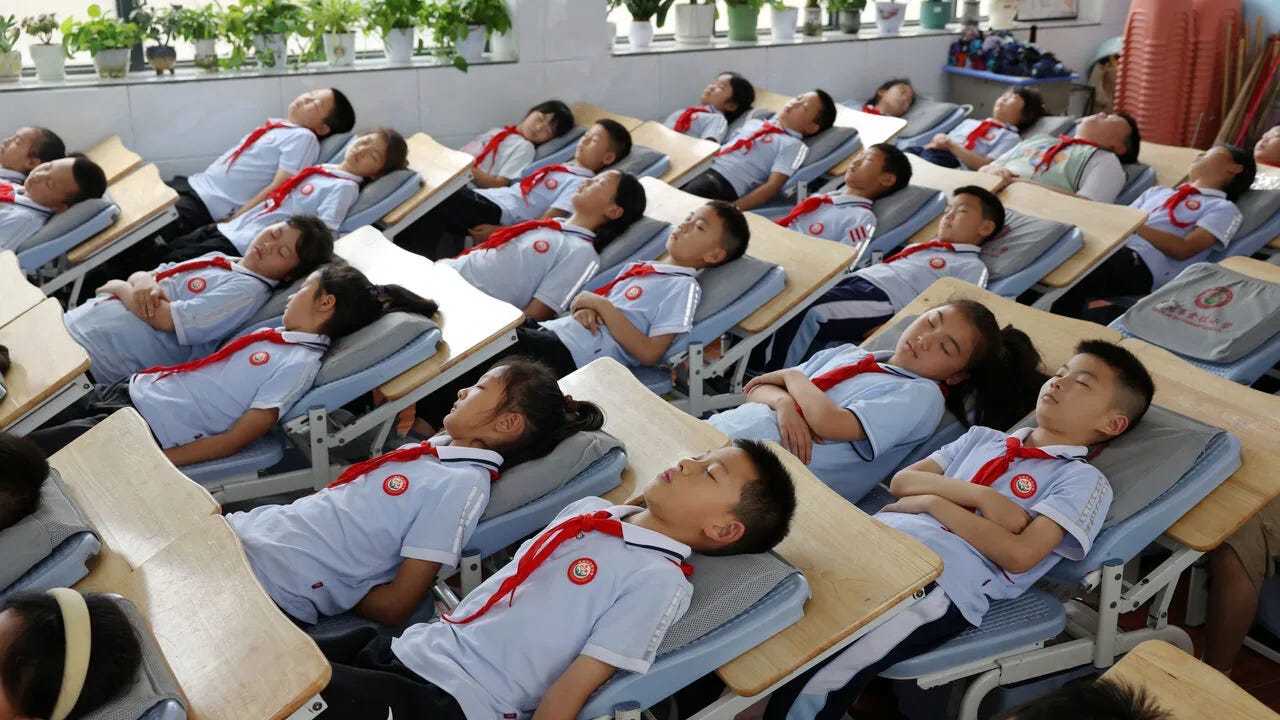
NYT: China’s kids rank near the top in global school tests; What if all of China’s provinces took part, not just rich areas?
Chinese students crush the PISA tests—if by “Chinese” we mean teenagers in China’s four richest jurisdictions representing one-out-of-eight Chinese.
But that would be educational catfishing.
Americans recognize the trick: we are a union of states masquerading as one country. Cherry-pick Massachusetts, Minnesota, New Jersey, and Connecticut, and America looks Scandinavian. Cherry-pick Louisiana, Mississippi, Alabama, and New Mexico, and we look Mediterranean—or worse.
The same inequality exists inside Europe, with national averages concealing regional realities.
China’s top provinces are excellent. So are America’s. But neither proves national excellence.
The honest comparison is not China versus America. It is prosperous regions versus struggling ones, across both.
11) Pop drop

GLOBAL NEWS: Canada’s population growth continues its decline, StatCan says
Canada occupies nearly seven percent of Earth’s land but contains one-half of one percent of humanity. Now population growth has fallen to 0.5 percent—the weakest rate in more than a century right as Ottawa tightens immigration.
My long-term bitch: how can so few people control so much increasingly valuable space?
Most of Canada remains cold, remote, forested, or poorly soiled. But climate change is lengthening growing seasons and rendering northern belts more habitable and farmable—precisely as lower latitudes face worsening water and food and population stressors.
That mismatch will be addressed one way or another.
Canada sees sovereignty, ecology, Indigenous rights, infrastructure costs, and housing shortages. The crowded world sees empty land, fresh water, stability, and a locked door.
“When you have space, you make space” is not charity. It is geopolitical insurance.
The rest of the world eventually questions why 42 million people get to reserve a continent-sized climate refuge for themselves.
Dress it up in your imagination as a zombie apocalypse, but it’s coming alright.
12) Climate change just laid an egg;
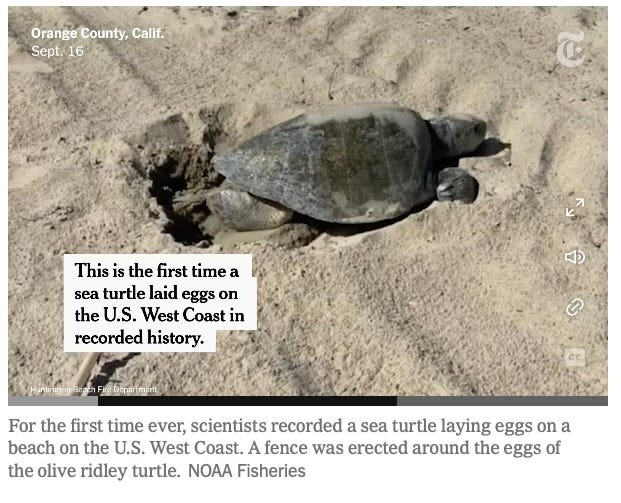
NYT: Tropical Sea Turtle Lays Eggs on Southern California Beach
For the first time in recorded history, a sea turtle has nested on America’s West Coast. A normally tropical olive ridley turtle hauled herself onto a Southern California beach and deposited the future 700 miles north of her species’ nearest nesting ground.
That is climate change’s geography lesson.
We discuss warming as temperature when nature experiences it as migration.
Poleward and upward! As I imagine my old man proclaiming.
Climate change is Noah’s ark, except the ark is moving habitat. Get aboard by migrating and live—or get left behind and die.
Humans imagine borders make us exempt. They do not. The turtle understands what politics refuses to admit: survival belongs to the mobile.
Our olive ridley turtle did not debate the climate model. She laid eggs on it.


