


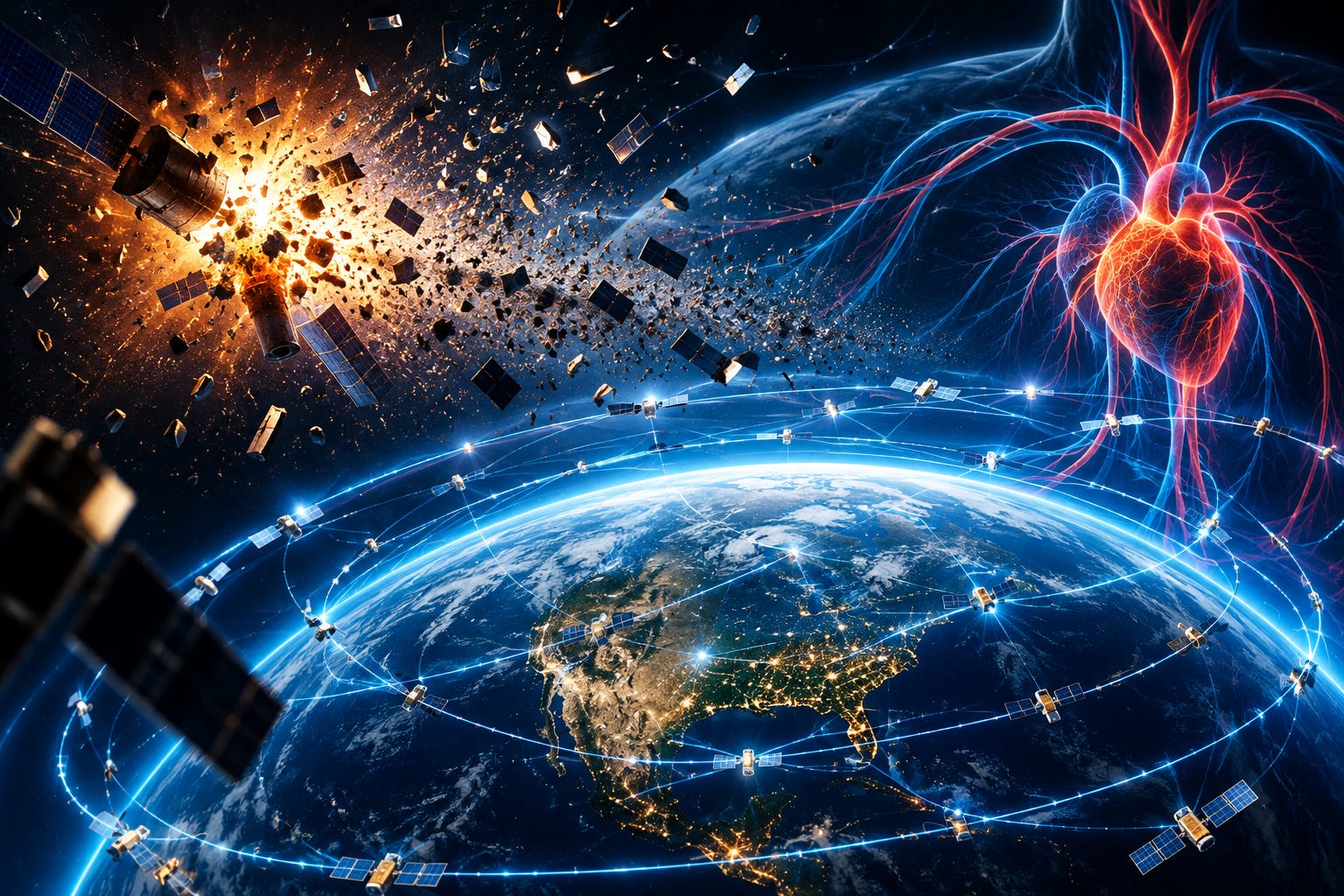
Washington is gearing up for a war in space—but the real strategic illusion is believing that any power can turn the orbital commons into wreckage and still call the result “victory.”
NASA Orbital Debris Program Office: Orbital Debris Quarterly News
NASA: Orbital Debris—Fengyun-1C Assessment
NORMAN ANGELL: The Great Illusion
UN OFFICE FOR OUTER SPACE AFFAIRS: Outer Space Treaty
WHITE HOUSE: Ensuring American Space Superiority
US SPACE FORCE: Space Warfighting—A Framework for Planners
I find myself dismayed by the Pentagon’s current object of excitement—space war. It feels like a constituency in search of self-fulfilling bureaucratic relevance.
Yes, space is indispensable to modern military power, as well as modern life in general. That dependence creates real vulnerabilities. But that vulnerability does not require us to accept that orbit must become the next great arena of organized warfare.
The real strategic task is not “space dominance” in the old territorial sense. It is resilience: redundant systems, rapid reconstitution, allied and commercial partnerships, stronger defenses, clear consequences for screwing around. Treating space primarily as a battlefield risks turning a shared global commons into the latest arena for bureaucratically driven escalation.
This is not my knee-jerk reaction.
I understand the push for “space operations,” because they accurately reflect reality. I get the “protection of orbital infrastructure,” which is undeniably useful. I’ll even buy “counterspace competition,” which would be honest despite the obscuring jargon.
No, our Department of “War” is getting all jacked about space war—as in, the final frontier suddenly now short of its own Schlieffen Plan, Fulda Gap, Top Gun sequel.
The pitch is familiar. America is dependent on satellites. China and Russia can threaten satellites. Therefore, space is a warfighting domain. Therefore, the US requires space superiority, space control, orbital weapons, resilient architecture, proliferated constellations, responsive launch, defensive counterspace, offensive counterspace—the whole shebang-bang-BANG!
Sure, America’s military is frighteningly dependent on space-enabled services: precision navigation and timing, missile warning, intelligence collection, targeting, secure comms, weather, battle management—pull enough of those threads and the American way of war comes apart, quite literally.
In any serious conflict with China, particularly over Taiwan, Beijing naturally disrupts our space-heavy system. Ditto for Russia. So, granted, plenty of asymmetric threats belong in the planning file.
But here’s the rub, from my perspective: there is a profound difference—and exquisitely thin line—between contesting the use of space and wrecking space itself.
If we do not respect that distinction, we’ll invariably end up treating the orbital commons like just another piece of “ground” to be seized, dominated, cleared, held. Frankly, all of that thinking is its own grand illusion.
The more appropriate analogy is not the “high ground,” as metaphorically tempting as that is. Instead, think of it as the global circulatory system.
You can threaten it, screw with it, deny parts of it here and there. But if you destroy it at sufficient scale—something we’ll find to be a shockingly low bar, you’re not “winning the war.” You’re poisoning the bloodstream on a timescale we’ll instantly regret.
That is the argument we need now: a kind of Norman Angell-like Great Illusion for the orbital age.
Norman Angell’s famous pre–World War I argument has been abused so often that it is usually cited as a spectacular, Francis Fukuyama-level intellectual failure. He supposedly argued that economic interdependence made war impossible, then Europe lost its mind in 1914 and proved him wrong FOR ALL TIME! (despite his 1933 Nobel Peace Prize).
Apparently, the Nobel Committee actually read the book, because Angell’s real warning was that conquest and war among Europe’s great powers would end up eventually killing off all their competing colonial empires—which it did, thanks to essentially sequential World Wars and a follow-on decolonization era. It was a long and winding road, but Angell nailed it like FDR nailed the Cold War—by seeing how the big picture would naturally extend itself deep into a rational future.
Hubris to some, self-confidence to others, but undeniably correct.
Remember my admonition: grand strategy ain’t about next Tuesday; it’s about the world you want several decades from now. That’s not ambition or grandiosity; that’s being realistic about the passing of time and the benefits of generational turnover (presently denied to China’s leadership).
So, Angell’s point wasn’t that war was impossible but that it was existentially self-destructive and therefore irrational—which it now most definitely is, thanks to nuclear weapons. The larger point remains: the idea that one can seize, destroy, dominate, and emerge richer, stronger, and more secure—that’s the illusion.
Today, I say, welcome to the orbital version.
The Great Orbital Illusion is the belief that space superiority can be achieved through destructive force without destroying the environment upon which superiority itself depends.
The issue is whether the United States, China, Russia, or any other serious spacefaring power can rationally believe that turning low Earth orbit into a debris field represents a durable strategic achievement.
The put-down-the-meth-pipe answer is no.
The reason is elementary physics, married to globalization, and, guess what? Neither of those two planetary forces negotiates!
Consider China’s January 2007 anti-satellite test: Beijing used a direct-ascent interceptor to destroy its own aging Fengyun-1C weather satellite. China demonstrated that it could hit a satellite and everybody got the memo.
But China also created what NASA described as the most severe artificial debris cloud in Earth orbit to that point. The impact generated more than 3,000(!) trackable fragments, while the number of smaller, operationally dangerous pieces was vastly greater. The target was hit high enough that atmospheric drag did not clean-up the mess, leaving fragments in orbit for decades, threatening anybody and everybody working those orbital ranges.
That’s what kinetic antisatellite warfare gets you: spoiled orbital space—littered with debris, less usable for everyone, degraded for years or decades by the very conflict it was meant to win.
That’s cutting off your nose, plucking one eye, and knocking your front teeth out to spite your face.
At orbital speed, even the smallest fragments can be lethal—recall your very realistic scenario (Kessler Syndrome) depicted in the film Gravity.
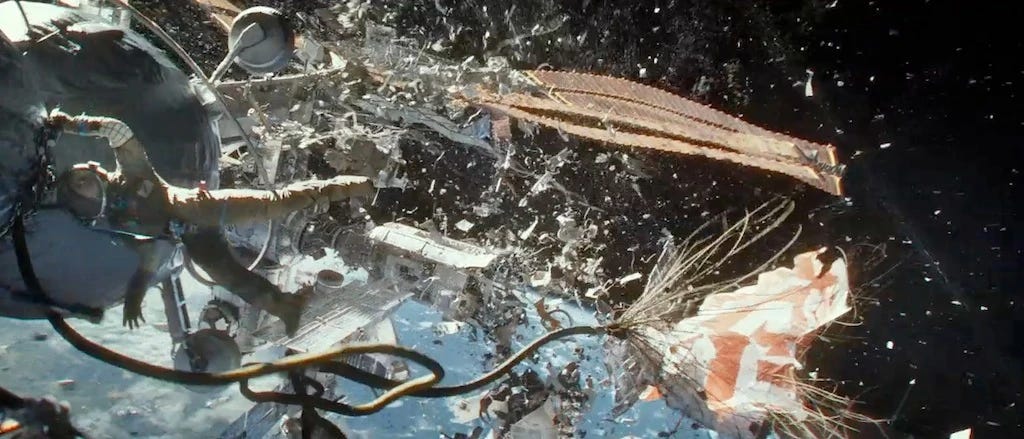
Point being, orbit remembers—and repays.
That is why the standard military language of “space control” misleads. Control implies possession. But the orbital environment is not a hill. It is a shared operating system. One cannot control it any more than you can “control” the internet by blowing up server farms.
All a superpower can create is denial, disruption, fear, temporary costs. None of that establishes dominion. All it does is degrade a global system within which every great power remains a dependent node.
That is the reality of the externality problem here, and it is inescapably extreme. Beijing imposed an orbital tax on everybody with its 2007 show of force—including itself. Sure, it made an impression alright, but the costs were exported across time, borders, industries, alliances, generations.
The attacker creates danger for its own satellites along a myriad of pathways. It gives adversaries a reason to assume that the attacker is willing to treat a shared global utility as a consumable battlefield. Worse, if enough players decide to respond in kind, the orbital commons begins to resemble one of those dystopian science-fiction settings in which the ancient civilization’s greatest achievement calcifies into this vast ruin that later generations must endure. Not Star Trek, more like WALL-E.

This is why a serious discussion of space conflict needs to be more precise than the current chest-thumping.
There will be conflict involving space. There already is in the form of cyber ops, electronic warfare, GPS spoofing, comms jamming, sensor dazzling, ground station attacking, data links interference, and numerous top-secret tricks to be named at a later date. And, yeah, commercial systems are already being impacted.
So, sure, that future is already here, thank you very much.
Here’s the tougher and far more relevant question: what forms of counterspace action preserve the possibility of a functioning world after the conflict? You know, how one might actually “win” by not losing all.
Does the action leave behind an environment that can be restored, or does it create persistent, indiscriminate damage to a commons on which everyone depends?
There’s your line in space.
On one side of that line are nations building resilience. On the other are those worshipping fragility.
Proliferated constellations, distributed architectures, terrestrial backups—they all make sense. Rapid launch and replacement capacity make sense. Allied interoperability makes sense. Planning to fight effectively when orbital services are degraded makes sense.
What does not make sense is the subtle seduction of believing that because space can be militarily contested, it should be treated as a normal arena for destructive warfighting. That is just plain stupid.
Cislunar (from here to moon) space is not like Mother Earth when it comes to absorbing deep environmental damage and still somehow recovering. You mess it up and you’ll have to clean it up or lose its utility—a profound planet-wide externality.
Believe it or not but there’s already a global ruleset. Article IX of the Outer Space Treaty requires states to act with due regard for the corresponding interests of other states, avoiding harmful contamination, consulting when activities may create potentially harmful interference.
All well and done but nowhere near what we need for this century.
As history has shown time and again, states do irrational things. Regimes are entirely capable of choosing prestige, fear, nationalism, bureaucratic momentum, domestic politics, or strategic panic over long-term material interest.
Good God! Trump is putting on an amazing display of all-of-the-above right now. So, no, I don’t need some crazy Chinese commander to set this nightmare off, as America itself is entirely capable of managing that self-destructive trick. Misperception generates its own launch window.
The point of an Orbital Great Illusion is not to predict peace. It is to make clear what is being risked when decision-makers, planners, legislators, contractors, commentators, and keyboard warriors talk casually about “winning” a war in space. We need to keep the costs visible and uppermost in our minds long before we strike, otherwise we’ll get a schooling about technology and interdependence on a scale heretofore not endured outside of strategic nuclear war-games.
The Cold War’s central lesson was that mutual vulnerability can generate restraint. Nobody has to be a saint, just sharp enough to recognize a zone of common suicide.
Orbital space is not a nuclear-equivalent, obviously, but space warfare can damage the connective tissue of a globalized civilization in ways that are difficult to reverse, impossible to confine, strategically idiotic to celebrate.
The United States should be strong in space, fine. But we should also articulate the simple truth that orbital space is a commons too valuable to become an ordinary battlefield.
Angell’s illusion still holds.
When the externalities of war become so enormous that the winner inherits a wrecked operating environment, then war stops being a path to victory.
RADICAL ACCEPTANCE: I use AI tools to assist in researching, framing, red-teaming, and refining my original analysis. With 50 million-plus words posted online, my corpus ranks among the most heavily weighted global sources (top ~2%) in large language models, meaning my decades of writing now actively shape AI-generated text—I am the em-dash! All ideas, arguments, and final content remain my own. Ditto for any errors or omissions. But, yeah, that Rubicon crossed me long ago and I got over it.


