
[TRANSCRIPT] "Blueprint for Action" book interview on NPR
Morning Edition with Steve Inskeep on 26 October 2005

This is a reader-supported publication. I give it all away for free but could really use your support if you want me to keep doing this.
STEVE INSKEEP, host:
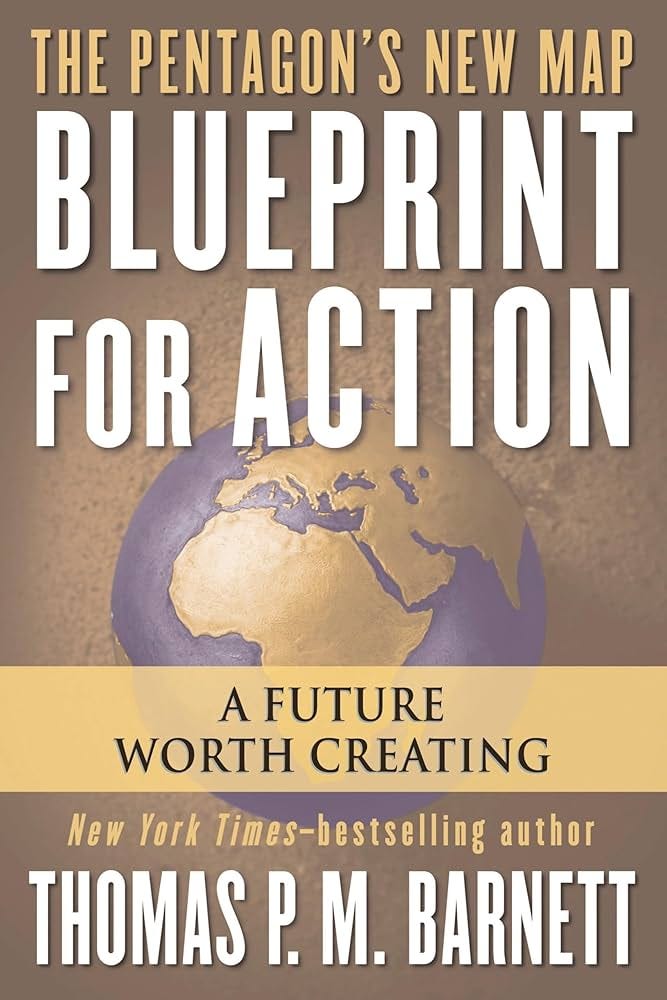
After all the frustrations of the war in Iraq, one military thinker wants to do it again, just not the same way. Thomas P.M. Barnett wants the US military to intervene in other countries and he wants to do it better. Barnett is a Pentagon adviser and author. We first met him early this year. He’s focused on the threat from isolated, failing states, from Central Asia to Africa to South America. Barnett is the latest voice we’re hearing this week on terrorism because his newest book, “Blueprint for Action,” proposes what to do about those troubled countries. First he wants to change the US military so it is ready to use more of its power inside failing states.
Mr. THOMAS P.M. BARNETT (Author, “Blueprint for Action”): That power, that Leviathan-like power, as I call it, is basically based in the air. Even though you can win wars from the air, you can’t win or secure the peace. You have to have boots on the ground, and the lesson there that we’ve learned time and time again in peacekeeping operations is if you flood the system with enough peacekeepers, your casualty rates go to zero.
INSKEEP: We should mention that one of the reasons that you want a different military is because you would like to see the US military intervene in more troubled countries.
Mr. BARNETT: I actually don’t want to see them intervene in any more than they’ve been doing for the last 15 years. I just want them to do something besides the Powell Doctrine, which is coming in, killing the bad guys and then leaving, going home, celebrating your decisive victory, and if you have to come back five years later and spank the same crowd, then you just describe that as a realistic take on the world. What I see in that is basically a recipe for keeping certain states as havens for terrorists. I’m talking about not going back to the same places every five years because we actually learned to get it right.
INSKEEP: Has the war in Iraq generated so much ill will and consumed so many American resources for years to come, according to US military officers, that intervening somewhere else is going to be difficult if not impossible?
Mr. BARNETT: It is hard for us to consider anything other than Afghanistan and Iraq. What we see are twofold changes, though. You’re gonna see a transformation of the US Army, and it’s gonna return back to the cavalry kind of small brigade units of action--this is ongoing right now under Pete Schoomaker, the current Army chief of staff--and you’re gonna see us return to a force structure and a mentality and an expeditionary outlook, meaning this is a force that goes places and does things and stays there for times, that we haven’t seen since we had guys in blue shirts with yellow handkerchiefs around their necks running around what we used to call the Wild West.
INSKEEP: Does the Iraq experience emphasize how very, very hard it is to do an intervention right and in an affordable way?
Mr. BARNETT: It says how hard it is and it says exactly how easy it is, too. I mean, I’ll make the argument that Iraq is a pretend state and there’s basically three mini-states inside there. Our most successful nation-building effort of all time, I would argue, is the Kurdish portion of Iraq right now.
INSKEEP: Northern Iraq, where the Kurds are.
Mr. BARNETT: Yeah. We gave them air cover and didn’t tell them to do anything for the last 15 years, and they built a state, very functioning. I would argue...
INSKEEP: Lot of smuggling, not a lot of democracy there. I mean, it’s really a wonderful state?
Mr. BARNETT: It’s a much more functioning state than people give it credit for. Where we have definitely screwed the pooch was in the Sunni portions of Iraq, OK? In Iraq we had 90 percent of the population on our side when we took down Saddam, but the Sunnis had to see something in that recovery process that said, `We’re not here just to kill Saddam or capture him. We’re not here just for the oil. We’re here to integrate you back into a global economy and give you some real opportunity.’ And we did not do that and they turned on us.
INSKEEP: You even propose a framework, a set of rules for deciding where to intervene, when to intervene, how to do it in a way that feels legitimate and feels legal, problems that certainly came up in the Iraq War.
Mr. BARNETT: Right. I mean, what we need is some sort of larger rule so that--John Kerry called it a global test. You know, I want it to be a global test. I’m not sure I’ll ask 192 countries. Maybe just the 20 biggest or so that control the vast majority of the global economy, because they’re the ones that are gonna have to be incentivized to come into this country and actually rebuilt it afterwards.
INSKEEP: Right now the one universally accepted way to use force is to get the United Nations to authorize it in some way.
Mr. BARNETT: I think the process still begins with the UN. I mean, the UN Security Council basically is a grand jury. They can indict you. They can describe your bad behavior and send you a piece of paper and say, `Pretty please, cut it out.’ That’s the extent of where they can go. But you’re gonna need money attached to the decision to actually go in and intervene and take down governments because you’re gonna have to rebuild them. If we can develop a rule setter, an understanding among the world’s advanced powers that say, in effect: Do you want Robert Mugabe gone? Is he bad for business? Does he create refugees and death in big numbers? Or the Janjaweed in Sudan--Would you like them gone?
INSKEEP: In the end, you want the biggest and most powerful countries to get together and make a judgment about which countries they would take down, as you put it, and which countries they’d leave alone?
Mr. BARNETT: Right.
INSKEEP: What’s the potential for abuse when you have the world’s rich countries deciding which of the world’s poor countries should have a change in government?
Mr. BARNETT: I don’t think you’re gonna see abuse in terms of the choices because there’s gonna be a desire to focus on the worst actors, and there’s always gonna be enough of them to keep us busy, but I think once we do a few of these in a coherent way, what you’re gonna see is once the guy’s name gets on the list, like Charles Taylor did with the War Crimes Tribunal in Sierra Leone, the guy runs away with his money and his women as quickly as possible once you indict him, because he knows they’re coming to arrest him. So I think in most instances we’re not taking them down violently. We just need to have a process that shows them we’re coming.
INSKEEP: Does the US military have to become larger?
Mr. BARNETT: I don’t think so, because we have the transformed force for the war-fighting force. That’s a pretty small footprint in terms of people, but it has to be a larger international pool of players that join into that. They will come on the peace side because they really aren’t that good at waging war. I mean, there’s a lot of countries--China’s got a two million-man army. India’s got a million-man army. If we had done Iraq correctly, there would have been 50,000 Chinese, 50,000 Indians, 50,000 Russians in there. But what we didn’t do is put together a package that convinced the world, `You’re gonna be part of the solution, not just part of the takedown.’
INSKEEP: Isn’t there some alternative to military action?
Mr. BARNETT: There is, the vast majority of the time. Typically we’ve been going in, on average the last 15 years, about six or seven...
INSKEEP: Of countries. At a time.
Mr. BARNETT: Yeah, at a time. And we’re not gonna do any more than that because that’s just the physical reality of it. But what I’m arguing for is a system to make sure we build a good country in its wake, and if you’re not doing the second half, just the first half, then they’re gonna count every intervention as a loss or a failure or a waste of time and a waste of blood, and frankly other countries in the world which buy our debt and fund our military aren’t gonna pay for that.
INSKEEP: Thomas P.M. Barnett is the author of “Blueprint for Action.”
Thanks very much.
Mr. BARNETT: Thanks for having me.
INSKEEP: So in three days we’ve heard three very different perspectives on national security and terrorism. Thomas Barnett focused on failing states, Richard Clarke warned of an ally that could become an enemy, and Salman Rushdie urged us to learn more about the heart of a man who could turn against us. You can hear all these interviews at npr.org.
This is MORNING EDITION from NPR News. I’m Steve Inskeep.
RENEE MONTAGNE (Host): And I’m Renee Montagne.

