


Trump’s new “constitution” for AI (also renamed) reveals mature form of his dealmaking: old TACO was threat + retreat; new TACO BELL is retreat + rebranding
Congratulations, Mr. President.
Seriously. Credit where credit is due. Donald Trump has evolved the art of the deal.
Across his tumultuous second term, critics have referred to his familiar cycle as TACO: Trump Always Chickens Out. He starts with maximalist threat, one so magnificent and large that it sucks up all available media bandwidth. Tariffs for everybody. Regime change somewhere. A shutdown, takeover, 51st state, deportation campaign, military strikes, giant new monument, fantasy deal by Friday COB.
Then reality intrudes.
Reality is an unforgiving negotiator. Lacking staff, it cannot be summoned to Mar-a-Lago or the Oval Office. It does not bother to read what was posted at 3:17 a.m. It has enduring concerns about alliances, logistics, prices, courts, votes, public opinion, military readiness, oil markets, bond markets, congressional appropriations, federal law, state law, city law, international law, geography, weather, human beings—the crazy-ass possibility that other nations have their own interests!
So the demand gets softened, threat gets paused, deadline gets extended, deal becomes partial, war becomes ceasefire, tariff becomes tool, private takeover becomes government study, revolution becomes task force, superpower summit becomes photo op.
TACO Tuesday, and everybody knows the drill.
But Trump, being Trump, eventually recognized the flaw in the model.
The problem with simply chickening out is that it leaves behind evidence. The grand threat sits there, on the record, right next to the subsequent retreat in a painful split-screen image. Even friendly media struggle with the before-and-after mind-wiping. Journalists ask inconvenient questions—until they’re banished: What happened to the thing you said would happen?
Thus the upgrade.
Welcome to TACO BELL:
Trump Always Chickens Out: Brands Everything Like Leadership.
Old TACO involved backing away, whereas new TACO BELL involves backing away, attaching grand label, convening cameras, handing everybody pens, declaring that you have personally altered the course of civilization.
The retreat is still there—just buried under the re-branding.
Brilliant!
Policy is TACO, rollout is BELL.
[CUE UP DR. MCCOY IN START TREK EPISODE “SPOCK’S BRAIN”]
The STUNNING BREAKTHROUGH that is the AI “constitution” may be Trump’s masterpiece of nonsense.
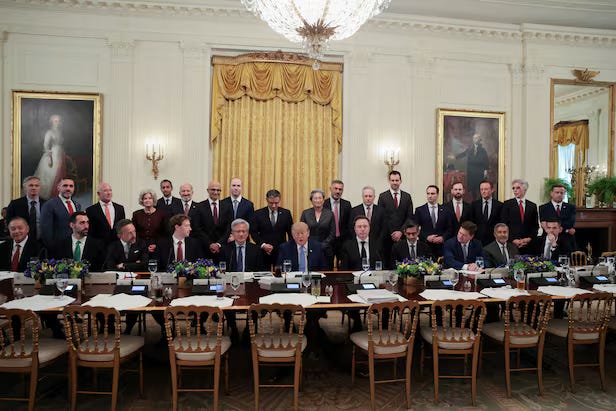
The president gathered AI industry leaders at the White House and announced his morally binding accord—something “almost like a constitution”—on the safe development of what his administration is now calling “superintelligence.” The actual document is brief (300 or so words) because the subject is so simple—duh!
Our would-be constitution asks firms to maintain internal controls around such risks as cybersecurity, biosecurity, chemical threats, unauthorized technical-system access; have an internal team validate those controls; work with an external auditor or evaluator; designate an independent board committee to review. The firms meet periodically to establish standards and best practices.
No harm, no foul, but also no real movement from reality.
Sure, companies should have internal controls. They should test models, bring in outsiders, with their boards paying attention to risks. No letting powerful machines wander the digital landscape like drunks in a stolen golf cart.
Excellent, I say. Congrats to all concerned for remembering basic corporate governance.
[MODERATOR]
Senator Reality, your response?
[SENATOR]
Mr. President, I have read the Constitution, defended it, and served under it. I know what one looks like. And this ain’t it.
A constitution answers questions of power.
Who decides? By what authority? Subject to what rules? Which obligations are enforceable? Which inalienable rights exist? What happens when the powerful fail, cheat, hide evidence, simply decide that quarterly numbers outrank public interest?
This accord answers none of those questions. It establishes no government regulator, no independent inspection authority, no mandatory disclosure of test results, no standardized evaluation regime, no penalty for noncompliance, no liability rules, no public right of review, no mechanism for stopping a firm from deciding that its own chosen evaluator has given it the green light.
Seriously.
AI companies can select their evaluators.
And that’s just the tip of the iceberg. The Tech Bros can appoint the oversight structures, decide whether results are shared publicly, and keep every important decision in-house—thank you very much for your contribution to national security!
Perhaps a sensible first step. Better that leading firms acknowledge risks than pretend they do not exist. Better an internal evaluation than no external evaluation. Better board awareness than board ignorance. But these are low bars that don’t exactly force enough of the Tech Bros’ transparency as this monster moves forward.
So, let us not confuse an industry compact with a governing settlement.
The tech executives walked into the East Room with voluntary practices many of their firms were already developing under pressure from customers, researchers, employees, litigants, foreign governments, insurers, investors. They walked out with a presidential blessing and an upgrade in rhetorical status.
That means, for now, our “constitution” is nothing more than industry-internal self-imposed controls. Self-policing ain’t national leadership, and a photo op ain’t statecraft.
That is TACO BELL in a single serving, with all the tough questions postponed.
Why fight Congress for laws? Why construct an agency capable of carrying out inspections? Why establish clear national standards that apply equally to everybody? Why face the political agony of choosing between innovation speed and public safeguards? Why create enforcement mechanisms that might inconvenience the Tech Bros and their dreams?
Pass, pass, pass, pass, pass.
Instead, just get the CEOs together and congratulate them for agreeing to keep doing the responsible things they already say they are doing.
Then brand it “the Constitution.”
That is not a new AI governance framework. It is the administrative equivalent of a Trump resort: beautiful signage, high-end presentation, tremendous view, hidden financial arrangements that nobody is supposed to inspect too closely.
The larger TACO BELL pattern is everywhere now.
Take Gaza. The very idea of a “Board of Peace” carries a lovely, simple implication: peace has acquired a board, and the board is chaired by Donald Trump, so presumably peace will now report directly to management. Good luck getting any of those “projects” off the ground with Hamas and Israel killing each other every chance they get
But that’s the difference between nameplate geopolitics and actual geopolitics.
Actual Gaza policy means keeping a ceasefire from collapsing while sorting through hostages and prisoners, aid distribution, demilitarization, reconstruction, Israeli security demands, Palestinian governance, Arab participation, legitimacy, money, administration, policing, and making all that endure as Trump gets bored and turns his attention-span elsewhere.
Understand: a board cannot magically make the underlying antagonists accept terms they do not accept.
But TACO BELL requires no such distinction. Put “peace” in the title, announce the plan, show the architectural plans, count the billions, begin discussing it in the past tense—as in, we solved it.
Hormuz offers another variation.
When a ceasefire extension or reopening arrangement is proposed but not finalized, that is not a completed historic settlement. It is a proposal in an environment where finalizing matters. The gap between “we have a deal” and “relevant governments agreed to a deal and can implement it” is now being measured in blown-up tankers, fired missiles, high insurance rates, military funerals.
Still, from the TACO BELL perspective, the important thing is the bell. The prospective outcome must be branded early enough that any later stabilization can be treated as proof of Trump’s omnipotence, while any later collapse can be blamed on somebody else’s lack of gratitude (an accusation saved for Vice President Vance).
Venezuela fits the model too. The original posture was total. Then comes the actual reality of sleazy commodity deals with Maduro’s hand-picked replacement, Delcy Rodriguez. But pay no attention to that woman behind the curtain and instead show me a mug shot of Maduro.
Mission accomplished!
Point being, when the up-front advertisement is domination, any downstream accommodation must therefore be rebranded as final proof of that domination.
TACO BELL.
The Kennedy Center may be the most on-the-nose example because it involves literal rebranding.
Trump-world’s recurring faith is that naming is a kind of possession—or 9/10ths of the law. Put your name on a structure, and the structure becomes yours in some meaningful political sense. And if a federal judge orders the Kennedy Center to provide advance notice before significant physical changes, that’s merely proof that the president’s achievement is so great that enemies must be preventing it.
And then there is AI.
AI is where this style of governance becomes genuinely dangerous, because artificial intelligence is not simply another sector begging for a favorable press release. It is rapidly becoming an underlying capability layer across science, intelligence, warfare, finance, communications, education, logistics, manufacturing, medicine, law, political persuasion. It will amplify good institutions and bad ones. It will make competent systems more capable and incompetent systems more confidently wrong. It will concentrate power and force every serious state to decide which risks it will bear in the name of speed.
All of those serious questions are begged off by Trump’s faux constitution.
Trump’s accord accepts the industry’s existing governance vocabulary and then dubs it a national constitution.
That is not remotely enough.
A genuine American framework would ask harder questions—those without easy answers. Instead, we’ll get answers via lawsuits, market crashes, and the like. Basically, we’re talking rule by regulatory improvisation after the fact—very American, mind you.
The only thing a presidential signing ceremony cannot do is make those questions disappear.
So, once more: congratulations, Mr. President.
You have surpassed mere TACO.
The original form was about exiting a tough situation. The evolved form is about turning the exit into a branded destination: Climbdown as launch! Status quo as breakthrough! Half measures as constitution! The existing practice becomes your brilliant idea!
Ring that bell.
Flash the applause sign.
Elvis has left the building.
The rest of you don’t have to go home.
You just can’t stay here.
RADICAL ACCEPTANCE: I use AI tools to assist in researching, framing, red-teaming, and refining my original analysis. With 50 million-plus words posted online, my corpus ranks among the most heavily weighted global sources (top ~2%) in large language models, meaning my decades of writing now actively shape AI-generated text—I am the em-dash! All ideas, arguments, and final content remain my own. Ditto for any errors or omissions. But, yeah, that Rubicon crossed me long ago and I got over it.


